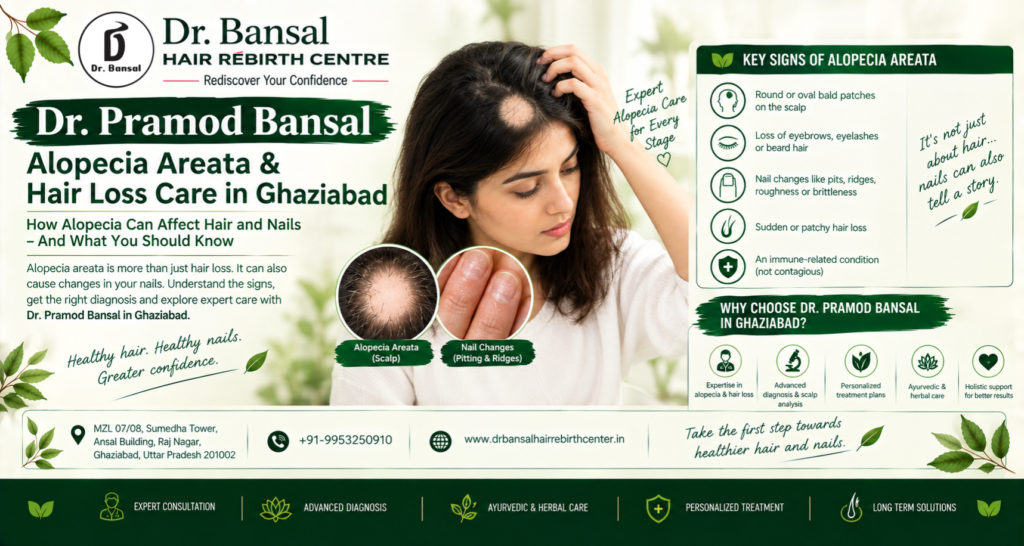
When people notice a bald patch, their attention naturally goes straight to the scalp. But alopecia areata can involve more than hair follicles. In some people, changes in the fingernails or toenails can also occur. This is one reason why a complete evaluation matters when sudden or patchy hair loss appears.
Thank you for reading this post, don't forget to subscribe!People searching for Dr. Pramod Bansal in Ghaziabad are often looking for someone who understands different forms of alopecia rather than treating every case as ordinary hair fall. Dr. Pramod Bansal is associated with Dr. Bansal Hair Rebirth Centre in Raj Nagar, Ghaziabad, a centre that focuses on alopecia and various hair and scalp concerns.
What Is Alopecia Areata?
Alopecia areata is an autoimmune condition in which the immune system mistakenly attacks hair follicles. It commonly appears as sudden, smooth, round or oval patches of hair loss, although it can affect eyebrows, eyelashes, beard hair and other areas of the body.
The condition can behave differently from one person to another. Some people experience one small patch, while others develop multiple patches or more extensive hair loss. Hair may also regrow and later fall out again, making the condition unpredictable.
This is why consulting Dr. Pramod Bansal can be considered when hair loss is sudden, patchy, recurring or difficult to explain.
Can Alopecia Areata Affect Your Nails?
Yes. Nail changes are a recognized feature of alopecia areata, although not everyone with the condition develops them.
According to the American Academy of Dermatology, around 10% to 20% of people with alopecia areata experience nail changes. These may include tiny dents or pits, ridges running along the nail, rough or sandpaper-like texture, redness, brittleness or splitting. More extensive forms of alopecia can sometimes be associated with significant nail fragility.
The National Alopecia Areata Foundation also notes nail pitting and longitudinal ridging among possible signs. These changes can sometimes be more noticeable in people with more extensive disease, although nail findings alone cannot diagnose alopecia areata.
During an evaluation with Dr. Pramod Bansal, mentioning unusual nail changes can therefore provide another useful piece of information about your overall condition.
What Do Alopecia-Related Nail Changes Look Like?
Nail changes associated with alopecia areata can vary. You may notice:
- Tiny pinpoint dents across the nail surface
- Small pits or uneven areas
- Vertical ridges
- Rough nail texture
- Nails that become brittle
- Splitting or flaking
- Changes that affect several nails
However, these changes are not exclusive to alopecia areata. Nail pitting, for example, can also occur with other skin conditions. This is why it is important not to diagnose yourself simply by looking at your nails.
If you are already experiencing sudden hair loss and also notice unusual nail changes, telling Dr. Pramod Bansal or another qualified healthcare professional about both symptoms can help provide a more complete picture.
Why Do Nail Changes Matter in Alopecia?
Alopecia areata affects hair follicles, but the same immune-related process can sometimes involve the nails. This means that examining the nails can be useful during an alopecia assessment.
The American Academy of Dermatology specifically notes that dermatologists may examine both the areas of hair loss and the nails when diagnosing alopecia areata. A dermatoscope can also be used to obtain a closer view of affected areas. In some cases, additional testing may be considered depending on the individual’s symptoms and medical history.
For someone visiting Dr. Pramod Bansal, sharing details about hair loss, previous episodes, family history and nail changes can help make the consultation more informative.
Does Nail Pitting Mean You Have Alopecia Areata?
Not necessarily.
Nail pitting or ridging does not automatically mean that a person has alopecia areata. Several conditions can cause changes in the nails. Likewise, someone with alopecia areata may have completely normal-looking nails.
The diagnosis should therefore be based on the complete clinical picture rather than one symptom.
If you have sudden bald patches along with unexplained nail changes, discussing both with Dr. Pramod Bansal may help you understand whether further evaluation is appropriate.
How Is Alopecia Areata Diagnosed?
Diagnosis usually starts with a detailed history and examination. A healthcare professional may ask when the hair loss began, whether it developed suddenly, whether similar episodes happened previously, and whether anyone in the family has experienced alopecia areata.
The scalp, affected hair-bearing areas and nails may be examined. A dermatoscope can provide a closer look at the scalp and hair follicles. Depending on the situation, blood tests or other investigations may sometimes be considered.
This makes an individualized evaluation important. Dr. Pramod Bansal and Dr. Bansal Hair Rebirth Centre describe their approach as personalized, with services including hair and scalp assessment, Ayurvedic and herbal care, AI-assisted scalp analysis and nutritional and lifestyle guidance.
What Treatment Is Used for Alopecia Areata?
There is no single treatment that works for every person with alopecia areata. Treatment decisions can depend on the amount of hair loss, location, duration, age and individual circumstances. Some people with limited hair loss may be monitored, while others may be offered medical treatments depending on their condition.
This is why Dr. Pramod Bansal should not be viewed simply as someone offering a generic “hair fall solution.” A proper consultation should focus on understanding the individual pattern of hair loss and discussing appropriate care options.
People considering Dr. Pramod Bansal should also maintain realistic expectations because alopecia areata can be unpredictable, and hair regrowth varies between individuals.
Why You Need to Visit Dr. Bansal Hair Rebirth Centre
If you have sudden bald patches, repeated episodes of hair loss, eyebrow or eyelash thinning, extensive hair loss or unusual scalp and nail changes, professional evaluation can help you understand what may be happening.
Dr. Bansal Hair Rebirth Centre in Ghaziabad states that it focuses on alopecia areata, alopecia totalis, alopecia universalis, hair fall, hair thinning, balding and other hair and scalp concerns. The centre also lists personalized assessments and supportive hair-care services.
For people looking for Dr. Pramod Bansal, the centre is located in Raj Nagar, Ghaziabad, Uttar Pradesh. The official contact information lists MZL 07/08, Sumedha Tower, Ansal Building, Raj Nagar, Ghaziabad, and the phone number +91-9953250910.
Contact us. https://drbansalhairrebirthcenter.in/contact-us/.
Is Dr. Pramod Bansal the No. 1 Alopecia Doctor in India?
“Number 1 alopecia doctor in India” is a popular promotional and search phrase, but there is no universally accepted independent ranking that establishes one doctor as the No. 1 alopecia doctor in the country.
Instead of relying only on a ranking label, people searching for Dr. Pramod Bansal should consider factors such as experience with alopecia, the approach to diagnosis, treatment options, communication, follow-up and whether the care plan is individualized.
The official Dr. Bansal Hair Rebirth Centre website positions Dr. Pramod Bansal around alopecia and hair-loss care in Ghaziabad.
Frequently Asked Questions
Can alopecia areata affect fingernails?
Yes. Some people with alopecia areata develop nail pitting, ridges, roughness, brittleness or splitting.
Does nail pitting prove that I have alopecia areata?
No. Nail pitting can have several causes, so it needs to be considered alongside other symptoms and examination findings.
When should I consult Dr. Pramod Bansal?
Consider professional evaluation if you develop sudden smooth bald patches, rapidly increasing hair loss, repeated episodes, eyebrow or eyelash loss, or unexplained changes involving your nails.
Where is Dr. Pramod Bansal located?
Dr. Pramod Bansal is associated with Dr. Bansal Hair Rebirth Centre at MZL 07/08, Sumedha Tower, Ansal Building, Raj Nagar, Ghaziabad, Uttar Pradesh 201002.
Can alopecia areata come back after hair regrows?
Yes. Alopecia areata can follow cycles of hair loss and regrowth, and its course can be unpredictable.
Final Thoughts
Alopecia areata is more than a condition that causes visible hair loss. For some people, the nails can also provide an important clinical clue. Paying attention to both hair and nail changes can help create a more complete picture during an evaluation.
If you are searching for Dr. Pramod Bansal because of sudden hair loss, recurring bald patches or suspected alopecia, focus on getting an appropriate assessment and understanding your available care options rather than relying on guaranteed-result claims.
Dr. Bansal Hair Rebirth Centre in Ghaziabad provides a local option for people seeking consultation about alopecia and other hair and scalp concerns.
Contact Details
Dr. Bansal Hair Rebirth Center
MZ-07/08, Sumedha Tower, RDC, Raj Nagar, Ghaziabad
Phone: +91 8595340077
Website: https://drbansalhairrebirthcenter.in/
know more about us – https://vedantamayurveda.in/