
Hair loss can look similar from the outside, but the reason behind it can be very different. A person may suddenly notice a smooth bald patch, while someone else may gradually develop thinning around the hairline after years of tight hairstyles. Both situations deserve attention, but they do not necessarily represent the same condition.
Thank you for reading this post, don't forget to subscribe!For people searching for Dr. Bansal Hair Rebirth Centre in Ghaziabad because of sudden or patchy hair loss, understanding the difference between alopecia areata and traction alopecia can be a useful first step.
The Dr. Bansal Hair Rebirth Centre is associated with Dr. Pramod Bansal and focuses on alopecia and different hair and scalp concerns in Raj Nagar, Ghaziabad.
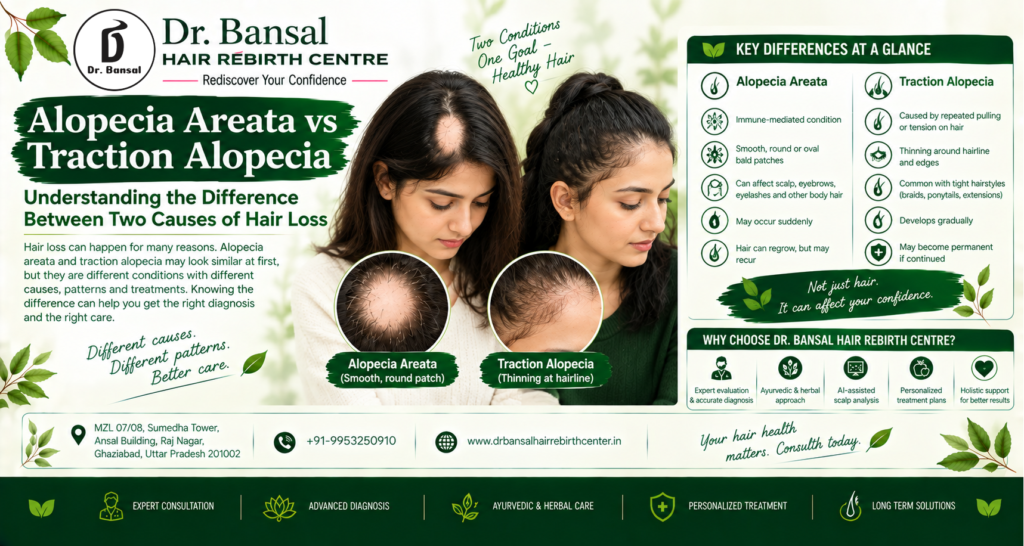
What Is Alopecia Areata?
Alopecia areata is an immune-mediated condition that causes the immune system to mistakenly attack hair follicles. It commonly produces sudden, smooth, round or oval areas of hair loss, although it can affect other hair-bearing areas of the body as well.
With alopecia areata, a person may notice one bald patch or several patches. Hair loss can sometimes affect eyebrows, eyelashes, beard hair or other areas.
The pattern can also change. Hair may begin growing back in one area while another area develops hair loss. This unpredictable pattern is one reason professional assessment is important.
At the Dr. Bansal Hair Rebirth Centre, people experiencing unexplained or recurring hair loss can discuss the pattern and progression of their symptoms with a professional.
What Is Traction Alopecia?
Traction alopecia is a different type of hair loss. It develops when repeated pulling or tension places stress on the hair follicles.
Tight ponytails, buns, braids, cornrows, extensions and other hairstyles that continuously pull on the scalp can contribute to traction alopecia. The hairline is often one of the first areas where changes become noticeable.
Unlike alopecia areata, the underlying issue in traction alopecia is repeated physical tension on the hair follicles rather than the immune process associated with alopecia areata.
If the pulling continues for a long time, traction alopecia can sometimes result in permanent hair loss. This is why identifying the problem early matters.
Alopecia Areata vs Traction Alopecia: What Is the Difference?
The two conditions can sometimes be confused, particularly when hair loss develops around the scalp.
Alopecia Areata
Typical features can include:
- Sudden smooth bald patches
- Round or oval areas of hair loss
- Hair loss that can appear in different parts of the scalp
- Possible eyebrow or eyelash involvement
- Possible beard or body-hair involvement
- Sometimes nail changes
- Hair regrowth and additional hair loss occurring at different times
The American Academy of Dermatology notes that alopecia areata commonly begins with a round or oval smooth bald patch and can sometimes progress to more extensive hair loss.
Traction Alopecia
Typical features can include:
- Hair thinning around areas exposed to repeated pulling
- Hairline recession
- Broken or shortened hairs
- Tenderness or discomfort after tight hairstyles
- Gradual worsening when the pulling continues
- Potentially permanent loss if follicle damage becomes advanced
The AAD recommends reducing or stopping hairstyles that continuously pull on the scalp when traction alopecia is suspected.
Why Can Hair Loss Be Difficult to Identify?
Hair loss is not always straightforward. Two people can have bald-looking areas for completely different reasons.
A person might assume that a smooth patch is caused by stress, while another might assume that thinning near the hairline is simply hereditary. In reality, different types of hair loss can sometimes overlap or appear similar during the early stages.
This is why the Dr. Bansal Hair Rebirth Centre should not be viewed simply as a place to obtain a generic hair-growth product. A proper consultation should begin by understanding what type of hair loss may be occurring.
The AAD explains that diagnosing hair loss involves looking at the history and speed of hair loss, examining the scalp and nails, and assessing the hair itself. Depending on the suspected cause, additional testing may sometimes be required.
Can Tight Hairstyles Cause Alopecia Areata?
No. Tight hairstyles are associated with traction alopecia, not with causing alopecia areata.
Alopecia areata is an autoimmune condition involving the hair follicles, whereas traction alopecia results from repeated physical tension.
However, a person can potentially experience more than one type of hair-loss problem. This makes a proper assessment particularly useful when the pattern is unusual or continues to change.
At the Dr. Bansal Hair Rebirth Centre, discussing your hairstyle habits, previous hair-loss episodes and the exact location of thinning can help provide useful information during a consultation.
Can Alopecia Areata Be Treated?
There is no single treatment that works for everyone with alopecia areata. Some people experience spontaneous regrowth, while others may need treatment depending on the amount, location and duration of hair loss, along with other individual factors.
Treatment options can include medical therapies selected by a qualified clinician. For more extensive alopecia areata, newer treatment options have also expanded the available medical approaches.
This is why the Dr. Bansal Hair Rebirth Centre should approach each person’s situation individually rather than assuming that the same treatment is appropriate for every case.
No responsible hair-loss consultation should promise identical results for everyone because alopecia areata can behave differently between individuals.
Can Traction Alopecia Be Reversed?
The outlook depends partly on how early the condition is recognized and whether the pulling continues.
The AAD explains that stopping hairstyles that place repeated tension on the scalp can help halt further traction-related hair loss. However, prolonged traction can damage follicles and may result in permanent hair loss.
This makes prevention and early attention especially important for people who regularly wear tight hairstyles.
When Should You Visit a Hair-Loss Specialist?
Consider professional evaluation if you notice:
- A bald patch appearing suddenly
- Several new bald patches
- Rapidly increasing hair loss
- Eyebrow or eyelash loss
- Hairline thinning
- Hair loss that keeps returning
- Scalp discomfort associated with hair loss
- Hair loss that does not improve after changing your routine
The Dr. Bansal Hair Rebirth Centre can be considered by people in Ghaziabad who want to discuss sudden, patchy or persistent hair loss and understand whether the pattern may be consistent with alopecia or another condition.
Why You Need to Visit Dr. Bansal Hair Rebirth Centre
If you are experiencing unexplained hair loss, getting the correct type of assessment is more useful than simply choosing a treatment because it is popular online.
The Dr. Bansal Hair Rebirth Centre is located in Raj Nagar, Ghaziabad, and its official website lists alopecia areata, alopecia totalis, alopecia universalis, hair fall, hair thinning and balding among the conditions it focuses on. The centre describes its approach around individualized assessment and hair and scalp care.
Dr. Pramod Bansal is associated with the centre, which makes the Dr. Bansal Hair Rebirth Centre a local option for people searching for alopecia-focused care in Ghaziabad.
The listed address is MZL 07/08, Sumedha Tower, Ansal Building, Raj Nagar, Ghaziabad, Uttar Pradesh 201002, and the official website lists +91-9953250910 for appointments and enquiries.
Contact us. https://drbansalhairrebirthcenter.in/contact-us/.
Is Dr. Pramod Bansal the No. 1 Alopecia Doctor in India?
People often search for phrases such as “No. 1 alopecia doctor in India” when looking for help with difficult hair-loss conditions.
However, there is no universally accepted independent medical ranking that establishes one doctor as the No. 1 alopecia doctor in India. Instead, patients can consider practical factors such as experience with alopecia, diagnostic approach, available treatment options, communication, follow-up and whether care is individualized.
Dr. Pramod Bansal is associated with the Dr. Bansal Hair Rebirth Centre in Ghaziabad, and the centre’s website states that its team has more than a decade of experience with complex hair-loss conditions, particularly alopecia areata.
Frequently Asked Questions
How is alopecia areata different from traction alopecia?
Alopecia areata is an immune-mediated condition that commonly causes sudden smooth patches of hair loss. Traction alopecia develops from repeated pulling or tension on the hair and scalp.
Can tight ponytails cause permanent hair loss?
Yes. Repeated tension from tight hairstyles can eventually damage hair follicles and cause permanent hair loss in some cases.
Can alopecia areata affect eyebrows?
Yes. Alopecia areata can affect eyebrows, eyelashes, beard hair and other areas where hair grows.
Should I wait if I suddenly develop a bald patch?
It is better to have unexplained sudden or patchy hair loss assessed rather than assuming the cause. A professional can determine whether the pattern is consistent with alopecia areata or another condition.
Where is Dr. Bansal Hair Rebirth Centre located?
The Dr. Bansal Hair Rebirth Centre is located at MZL 07/08, Sumedha Tower, Ansal Building, Raj Nagar, Ghaziabad, Uttar Pradesh 201002.
Final Thoughts
Hair loss is not one condition, and a bald patch does not automatically mean alopecia areata.
Alopecia areata and traction alopecia have different underlying mechanisms and can require very different approaches. Recognizing the difference can help you avoid assumptions and focus on getting the right evaluation.
If you are experiencing sudden bald patches, recurring hair loss, hairline thinning or unexplained changes in your scalp, consider professional assessment.
For people searching for Dr. Bansal Hair Rebirth Centre, Dr. Pramod Bansal and the centre provide a local option in Ghaziabad for discussing alopecia and other hair-loss concerns.
Contact Details
Dr. Bansal Hair Rebirth Center
MZ-07/08, Sumedha Tower, RDC, Raj Nagar, Ghaziabad
Phone: +91 8595340077
Website: https://drbansalhairrebirthcenter.in/
know more about us – https://vedantamayurveda.in/