
Hair loss is usually associated with thinning, shedding or bald patches, but sometimes people notice something unexpected: alopecia areata and sudden white hair appearing around the same time. Seeing lighter or white hairs where you previously had darker hair can naturally raise questions about whether the hair is permanently changing colour.
Thank you for reading this post, don't forget to subscribe!The connection between alopecia areata and sudden white hair is interesting because hair regrowth can sometimes look very different from the hair that was lost. In some people, new hairs may initially grow back white or blonde before gradually becoming closer to their natural colour.
Understanding why this happens can make an unusual change in your hair less confusing.
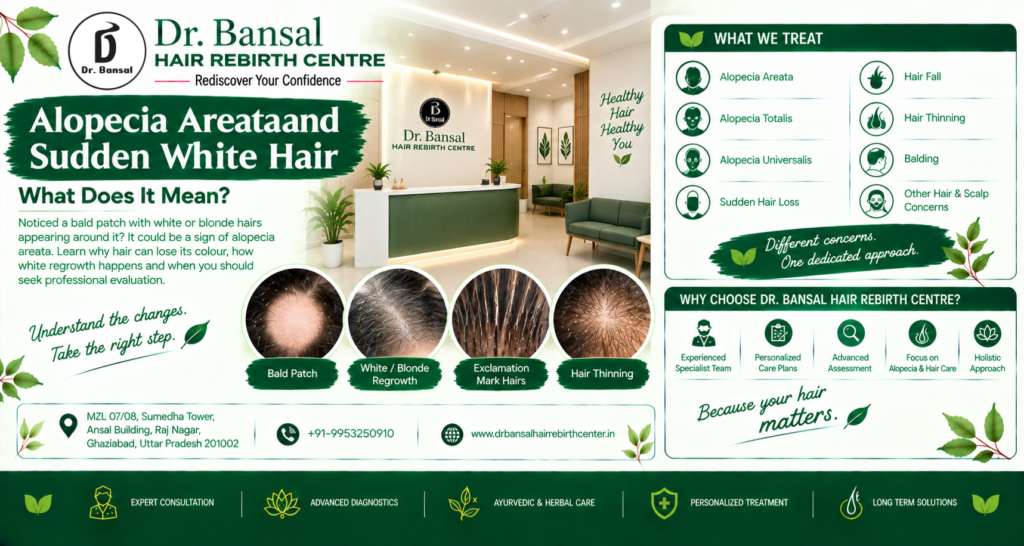
What Is the Connection Between Alopecia Areata and Sudden White Hair?
Alopecia areata is a condition in which the immune system mistakenly affects hair follicles. It commonly produces sudden, smooth, round or oval patches of hair loss, although other patterns are possible.
The connection between alopecia areata and sudden white hair can become noticeable during an episode of hair loss or regrowth.
When hair begins growing again, the new strands may initially contain less pigment than the surrounding hair. As a result, a person with naturally dark hair may suddenly notice white, grey or very light hairs in an area that previously appeared bald.
This can make alopecia areata and sudden white hair seem like two separate problems, even though they may be connected to the same hair-growth cycle.
Can Alopecia Areata Make Hair Turn White?
Alopecia areata does not necessarily mean that all of your existing hair suddenly changes colour.
Instead, alopecia areata and sudden white hair are often noticed when pigmented hairs are affected differently from lighter hairs or when new hairs grow back without their usual pigment.
During regrowth, hair can initially appear white or blonde and finer than before. The colour and texture may later become more similar to the person’s normal hair.
This is one reason why alopecia areata and sudden white hair can be surprising for someone who has never experienced this pattern before.
Why Does New Hair Sometimes Look White?
Hair colour is determined by pigment produced during the hair-growth process. When a hair follicle produces a new strand, the amount of pigment incorporated into that strand affects its appearance.
During recovery from alopecia areata, a new hair may initially grow with little or no visible pigment. This can make it appear white or blonde.
Therefore, alopecia areata and sudden white hair do not necessarily mean that the hair follicle has permanently lost its ability to produce coloured hair.
As the growth cycle continues, the appearance of the hair may change again. However, the experience is different for every person.
Can White Hair Appear Before Hair Loss?
Hair colour changes around an alopecia areata episode can be confusing because the timing may vary.
Some people first notice a bald patch. Later, they may see fine white or blonde hairs appearing in that area. Others may notice that darker hairs seem to disappear while lighter hairs remain more visible.
This can make alopecia areata and sudden white hair appear to happen at exactly the same time.
The important point is that hair colour alone cannot confirm alopecia areata. A proper evaluation considers the pattern of hair loss, the scalp appearance, the timing and other signs.
Is Sudden White Hair Always Related to Alopecia Areata?
No.
Not every episode of alopecia areata and sudden white hair represents the same situation, and white or grey hair can occur for many reasons unrelated to alopecia areata.
Age, genetics and normal changes in pigmentation can all influence hair colour. A person may also have naturally occurring grey or white hairs that become more noticeable after surrounding darker hair is lost.
This is why alopecia areata and sudden white hair should be considered in the context of the complete hair-loss pattern rather than based only on colour.
If white hairs appear together with a sudden smooth bald patch, recurring hair loss or noticeable changes in other areas, professional assessment can provide more clarity.
What Does Alopecia Areata Regrowth Look Like?
Understanding normal regrowth can help explain the connection between alopecia areata and sudden white hair.
Regrowing hair may initially be:
- White or blonde
- Finer than surrounding hair
- Shorter than nearby strands
- Uneven in length
- Less dense than the original hair
Over time, some regrowing hairs may become darker and thicker. However, regrowth does not always happen at the same speed across the entire affected area.
This means that alopecia areata and sudden white hair can sometimes be noticed during a period when the scalp is actually showing signs of new growth.
Does White Regrowth Mean the Hair Is Healthy?
White regrowth can indicate that hair is growing again, but its presence alone cannot tell you whether the underlying condition is active or improving.
With alopecia areata and sudden white hair, the appearance of new strands should be considered alongside the overall pattern.
For example, a professional may look at whether the bald area is becoming smaller, whether new patches are developing and whether the hair density is changing.
A close scalp examination can also reveal features that are difficult to identify by simply looking in a mirror. Magnification may be used during an assessment when necessary.
Can Alopecia Areata Come Back After White Hair Regrows?
Yes, alopecia areata can follow an unpredictable course.
Some people experience one episode followed by regrowth, while others experience repeated periods of hair loss and regrowth.
Therefore, alopecia areata and sudden white hair should not automatically be interpreted as either permanent recovery or permanent hair damage.
The important thing is to monitor changes in the affected area and seek professional evaluation when the pattern is unclear or continues to change.
When Should You Get Alopecia Areata and Sudden White Hair Checked?
Consider professional evaluation if alopecia areata and sudden white hair appear together with:
- A sudden smooth bald patch
- Rapidly increasing hair loss
- Several new bald areas
- Eyebrow or eyelash hair loss
- Hair loss in other body areas
- Repeated episodes of hair loss
- Unusual nail changes
- Persistent or unexplained changes to the scalp
Sudden hair loss can have different causes, so identifying the pattern is important.
Why You Need to Visit Dr. Bansal Hair Rebirth Centre
If you are concerned about alopecia areata and sudden white hair, particularly in Ghaziabad or nearby areas, an individual hair and scalp assessment can help you understand what may be happening.
Dr. Bansal Hair Rebirth Centre in Raj Nagar, Ghaziabad, focuses on alopecia and different hair and scalp concerns. The centre describes its approach as personalized, with attention to individual hair-loss patterns and scalp concerns.
A consultation can be useful when alopecia areata and sudden white hair occur together because the appearance of white regrowth should be considered alongside the shape, extent and progression of hair loss.
The centre is located at MZL 07/08, Sumedha Tower, Ansal Building, Raj Nagar, Ghaziabad, Uttar Pradesh 201002.
Contact us. https://drbansalhairrebirthcenter.in/contact-us/.
Frequently Asked Questions
Can alopecia areata cause white hair?
Hair growing back after alopecia areata can initially appear white or blonde, particularly when the new hair has little visible pigment.
Does white regrowth mean the hair will always stay white?
Not necessarily. Regrowing hair can later become closer to its previous colour and texture, although the outcome varies between individuals.
Is sudden white hair always caused by alopecia areata?
No. Hair colour can change for many reasons. White hair should be considered alongside other signs rather than treated as proof of alopecia areata.
Can alopecia areata cause both hair loss and regrowth?
Yes. Hair loss and regrowth can occur in cycles, and the timing can vary considerably between people.
When should I visit Dr. Bansal Hair Rebirth Centre?
Consider an assessment when sudden bald patches, recurring hair loss or unusual white regrowth are difficult to explain or continue changing.
Final Thoughts
The relationship between alopecia areata and sudden white hair can look unusual, especially when new white or blonde hairs appear inside an area that previously had no visible hair.
In many cases, this change can be part of the regrowth process. New hair may initially be finer and lighter before becoming more similar to the surrounding hair. However, white hair by itself cannot diagnose alopecia areata.
If you notice alopecia areata and sudden white hair together, focus on the complete picture: when the hair loss began, how the affected area is changing, whether new patches are appearing and whether regrowth is occurring.
Understanding these changes can help you approach sudden hair loss with better information and know when professional evaluation may be appropriate.
Contact Details
Dr. Bansal Hair Rebirth Center
MZ-07/08, Sumedha Tower, RDC, Raj Nagar, Ghaziabad
Phone: +91 8595340077
Website: https://drbansalhairrebirthcenter.in/
know more about us – https://vedantamayurveda.in/