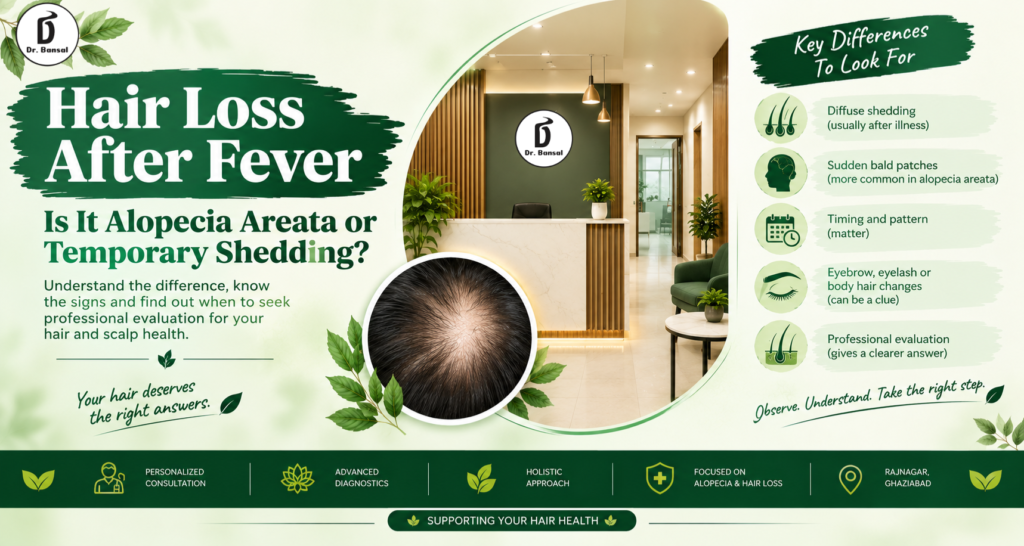
Noticing extra hair on your pillow, comb, or shower floor after recovering from a fever can be worrying. Many people immediately wonder whether the illness has caused permanent hair loss or whether it could be alopecia areata.
Thank you for reading this post, don't forget to subscribe!The good news is that Hair Loss After Fever does not always mean alopecia. A high fever or significant illness can temporarily disturb the normal hair-growth cycle and lead to increased shedding. At the same time, sudden patchy hair loss can sometimes point toward alopecia areata, which behaves differently.
Understanding the pattern, timing, and appearance of Hair Loss After Fever can help you know when it may simply be temporary shedding and when professional evaluation is worth considering.
Why Can Hair Loss Happen After a Fever?
Your hair does not grow continuously at the same rate. Hair follicles move through different stages of growth, resting, and shedding. A significant physical stress such as a high fever or illness can temporarily disturb this cycle.
In this situation, increased shedding often does not happen immediately. Many people notice it a few months after recovering from the illness. The shedding may appear throughout the scalp rather than as one clearly defined bald patch.
This type of Hair Loss After Fever can therefore seem confusing because the fever may have disappeared long before the hair starts falling more noticeably.
What Does Hair Loss After Fever Usually Look Like?
One of the most useful things to observe is the pattern.
Temporary Hair Loss After Fever often looks like:
- More hair than usual on your pillow or clothing
- Increased hair fall while washing or brushing
- Overall reduction in hair density
- A thinner-looking ponytail or hairstyle
- Hair becoming noticeably less full across the scalp
- Shedding from different areas rather than one smooth bald spot
The scalp may otherwise look relatively normal.
If the shedding begins several weeks or months after a significant fever and is spread relatively evenly across the scalp, temporary shedding may be one possibility. However, the exact cause cannot be determined from timing alone.
When Could Hair Loss After Fever Be Alopecia Areata?
Alopecia areata can also appear suddenly, but its pattern is often different from ordinary post-illness shedding.
Instead of simply noticing more loose hairs, you may discover a clearly defined area where hair has disappeared. Alopecia areata commonly produces smooth, round or oval patches of hair loss, although its appearance can vary. It can also affect areas such as eyebrows, eyelashes, beard hair, or other hair-bearing parts of the body.
This means Hair Loss After Fever should not automatically be blamed on the fever if you are seeing a distinct bald patch.
In some people, an illness or physical stress may occur around the same period as an alopecia areata flare. However, the presence of a fever does not prove that alopecia areata caused the hair loss.
Hair Loss After Fever vs. Alopecia Areata
Knowing a few basic differences can make the situation easier to understand.
Temporary shedding after illness may involve:
- Hair falling from all over the scalp
- Noticeably increased shedding
- A delay between illness and hair fall
- Gradual improvement as the hair cycle returns to normal
Alopecia areata may involve:
- Sudden smooth bald patches
- Round or oval areas with reduced or absent hair
- Hair loss in eyebrows, eyelashes, beard, or other areas
- New patches appearing over time
- Periods of hair loss followed by regrowth
There can also be less typical forms of alopecia areata, so appearance alone is not always enough to determine the cause.
How Long Can Hair Loss After Fever Last?
The duration can vary depending on the reason for the shedding and the individual’s overall health.
Temporary shedding after a physical stressor often becomes noticeable a few months after the event and may gradually settle as the normal hair cycle recovers. Hair fullness can take additional time to return because new hairs need time to grow.
This is why Hair Loss After Fever can feel more alarming than it actually is. You may already feel completely recovered from the illness while your hair is still responding to what happened earlier.
Alopecia areata is different because its course can be unpredictable. Some people experience regrowth, while others may develop additional patches or experience future episodes.
Can You Tell the Cause by Looking at Your Hair?
Sometimes the pattern provides useful clues, but looking at your hair alone cannot always establish the diagnosis.
A professional assessment may involve discussing:
- When the fever or illness occurred
- When the hair shedding began
- Whether the loss is diffuse or patchy
- Whether eyebrows, eyelashes, or body hair are affected
- Whether you have experienced similar episodes before
- Whether there are noticeable scalp or nail changes
- Whether the hair loss is continuing or beginning to improve
A scalp examination can provide additional information and help distinguish different patterns of hair loss.
What Should You Do If Hair Loss After Fever Continues?
If you notice increased shedding after an illness, try not to panic or assume that you are permanently losing your hair.
Instead, pay attention to the pattern and timeline. Take note of when the fever occurred and when the shedding started. Also observe whether the hair loss remains spread across the scalp or whether clearly defined bald areas begin to appear.
If Hair Loss After Fever is sudden, severe, persistent, recurring, or accompanied by smooth bald patches, eyebrows or eyelashes becoming thinner, or unusual changes in the scalp or nails, a professional hair and scalp evaluation can be helpful.
Avoid assuming that every type of hair fall has the same cause. Different conditions can look similar initially but require different approaches to evaluation and care.
Why You Need to Visit Dr. Bansal Hair Rebirth Centre
If you are experiencing Hair Loss After Fever in Ghaziabad or nearby areas and are unsure whether you are dealing with temporary shedding or alopecia areata, getting the pattern properly assessed can provide greater clarity.
Dr. Bansal Hair Rebirth Centre in Raj Nagar, Ghaziabad, focuses on alopecia and a range of hair and scalp concerns. The centre states that it provides personalized assessment for conditions including alopecia areata, alopecia totalis, alopecia universalis, hair fall, hair thinning, and balding.
A consultation can be particularly useful when Hair Loss After Fever does not follow a simple pattern, continues to worsen, or is accompanied by clearly defined bald areas.
The centre is located at MZL 07/08, Sumedha Tower, Ansal Building, Raj Nagar, Ghaziabad, Uttar Pradesh 201002. The official contact number is +91-9953250910.
Contact us. https://drbansalhairrebirthcenter.in/contact-us/.
Frequently Asked Questions
Is Hair Loss After Fever normal?
Temporary increased shedding can occur after a significant fever or illness. It often becomes noticeable a few months after the illness rather than immediately.
Does Hair Loss After Fever mean I have alopecia areata?
No. Post-illness shedding and alopecia areata can have different patterns. Sudden smooth bald patches are more suggestive of alopecia areata than general shedding.
Can alopecia areata happen after an illness?
An illness or physical stress may occur around the same period as an alopecia areata flare, but the timing alone does not establish the cause.
When should I worry about Hair Loss After Fever?
Consider professional evaluation if the loss is severe, persistent, rapidly changing, recurring, or appears as clearly defined bald patches.
Can hair grow back after Hair Loss After Fever?
Temporary post-illness shedding often improves as the hair-growth cycle returns to normal. Regrowth takes time because new hair needs time to grow.
Final Thoughts
Hair Loss After Fever can be unsettling, especially when it appears weeks or months after you thought you had completely recovered. However, increased shedding after an illness does not automatically mean permanent hair loss or alopecia areata.
The most important clues are the timing, pattern, amount, and progression of the hair loss. Diffuse shedding after a fever may represent temporary disruption of the hair cycle, while sudden smooth bald patches deserve closer attention because alopecia areata can present this way.
If you are uncertain about what is happening, getting your hair and scalp properly evaluated is better than trying to guess the cause from shedding alone.
Contact Details
Dr. Bansal Hair Rebirth Center
MZ-07/08, Sumedha Tower, RDC, Raj Nagar, Ghaziabad
Phone: +91 8595340077
Website: https://drbansalhairrebirthcenter.in/
know more about us – https://vedantamayurveda.in/