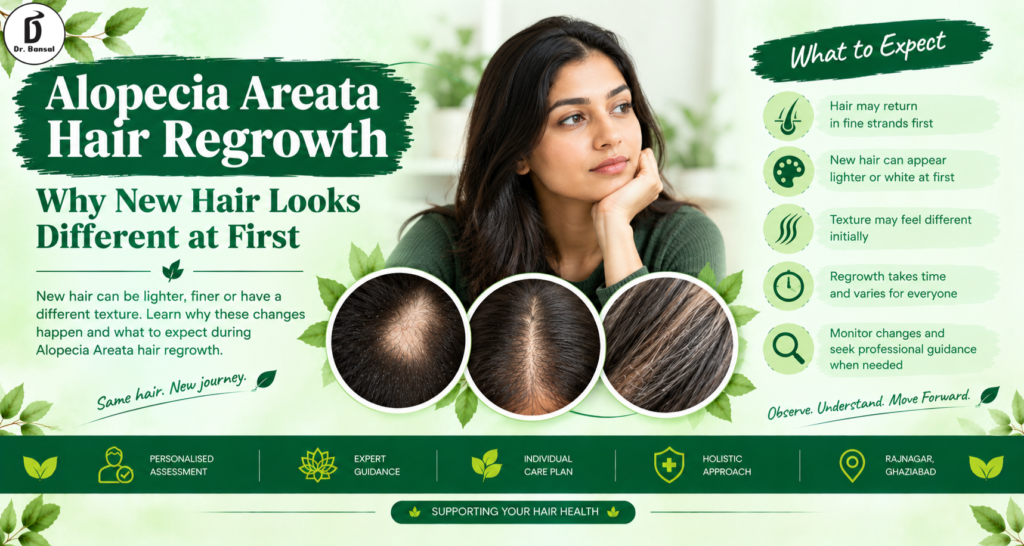
Noticing new hair in an area that previously had a bald patch can bring relief and hope. However, some people are surprised when the new strands look lighter, finer, softer or different in texture from their original hair. This can raise questions about whether the hair is growing normally or whether the condition is returning.
Thank you for reading this post, don't forget to subscribe!Understanding Alopecia Areata Hair Regrowth can help you recognise changes without worrying unnecessarily about every difference in appearance. Hair may return gradually, and its early appearance does not always reflect how it will look later.
This guide explains why regrowing hair can look different, which changes are worth monitoring and when professional guidance may be helpful.
What Happens During Alopecia Areata Hair Regrowth?
Alopecia areata is an immune-related condition in which the immune system mistakenly targets hair follicles. This can interrupt the normal hair-growth cycle and cause smooth, round or oval patches of hair loss.
Alopecia Areata Hair Regrowth may begin when affected follicles resume producing hair. Some people notice tiny, fine strands appearing within a previously bare patch, while others experience more gradual changes that are difficult to see at first.
The process is not identical for everyone. Hair may return in one area while another patch remains unchanged or develops later. Some people experience complete regrowth, while others have recurring episodes.
It is important to remember that the appearance of new hair alone cannot predict the long-term course of the condition.
Why Can New Hair Look White or Lighter?
One of the most noticeable features of Alopecia Areata Hair Regrowth is that new strands may initially appear white, grey or lighter than the surrounding hair.
Hair colour depends on pigment produced within the hair follicle. In some cases, pigment-producing activity may recover at a different pace from hair production. As a result, new hair can appear lighter before its colour changes.
This does not automatically mean that the regrowth is unhealthy or that the condition is getting worse.
However, not every white strand has the same explanation, and hair colour cannot reliably predict whether alopecia areata will improve or return. If you notice other changes alongside regrowth, discuss them during a professional assessment.
Why Is Regrowing Hair Sometimes Fine and Soft?
Early Alopecia Areata Hair Regrowth may appear delicate, short or less dense than the surrounding hair.
This can make a recovering patch look different even when new strands are becoming visible. The hair may gradually increase in length and thickness, but the pace varies between individuals.
Several observations may help you understand the changes:
- Fine strands may become more noticeable over time.
- Hair may initially grow at different lengths across the affected area.
- The density may look uneven while the patch is filling in.
- The new strands may have a different texture from nearby hair.
- Changes can occur gradually rather than all at once.
Avoid judging progress from a single photograph. Comparing occasional pictures taken in similar lighting can provide a more useful picture of change over time.
Can Hair Regrow With a Different Texture?
Yes. Some people notice that regrowing hair feels curlier, straighter, softer or coarser than their previous hair.
During Alopecia Areata Hair Regrowth, differences in texture may be temporary, although the outcome varies. Hair texture can also be influenced by natural variation, styling practices, breakage and changes in the surrounding hair.
For example, a short new strand may feel different from a longer strand simply because it has not yet reached the same length. Lighting and the direction of hair growth can also make a patch appear uneven.
Do not assume that a texture change automatically indicates a problem. If the area continues to lose hair, develops irritation or shows other unusual changes, seek appropriate guidance.
How Long Does Alopecia Areata Hair Regrowth Take?
There is no single timeline for Alopecia Areata Hair Regrowth. Some people notice early strands within a few months, while others experience a slower or more variable course. In some cases, regrowth may be incomplete or hair loss may recur.
The size of a bald patch alone cannot reliably predict when it will fill in. The extent of the condition, its course and individual factors can all influence what happens next.
Rather than comparing your progress with another person’s experience, focus on changes in your own affected areas. A professional can help assess the pattern and discuss realistic expectations without promising a particular result.
How Can You Monitor New Hair Growth?
Monitoring Alopecia Areata Hair Regrowth does not need to become a daily routine. A few simple habits can help you track changes while avoiding unnecessary stress.
Take occasional photographs: Use similar lighting, angles and hair positioning to make comparisons more meaningful.
Record noticeable changes: Note when new strands appear, whether a patch seems to be filling in and whether new areas of hair loss develop.
Handle your hair gently: Avoid forceful brushing, repeated pulling and hairstyles that place excessive tension on the roots.
Maintain balanced daily habits: Adequate sleep, balanced nutrition and gentle scalp care support general wellbeing, although they cannot guarantee regrowth.
Arrange follow-up when needed: If hair loss returns, spreads or is accompanied by scalp symptoms, seek professional assessment instead of relying on photographs alone.
When Should You Seek Professional Guidance?
Even when Alopecia Areata Hair Regrowth appears to be progressing, changes in other areas may deserve attention.
Consider an assessment if you notice new bald patches, increasing hair loss, changes affecting eyebrows or eyelashes, or persistent scalp redness, scaling, itching or discomfort.
A professional can examine the affected areas, review your history and consider whether the pattern is consistent with alopecia areata or another condition.
Avoid assuming that every new strand means the condition has permanently resolved. Similarly, do not assume that lighter or finer regrowth means that recovery has failed. The overall pattern matters more than any single feature.
Why You Need to Visit Dr. Bansal Hair Rebirth Centre
Understanding Alopecia Areata Hair Regrowth can be challenging when the hair changes in colour, texture or density. An individual assessment can help you discuss these changes and understand what they may mean in the context of your hair-loss history.
At Dr. Bansal Hair Rebirth Centre, you can discuss previous bald patches, changes in new hair growth and concerns about recurring hair loss. A personalised assessment can help clarify possible explanations and determine what further evaluation or hair-care guidance may be appropriate.
Before your visit, consider bringing occasional photographs and noting when regrowth began, whether other patches have appeared and whether you have experienced similar episodes before.
Contact Dr. Bansal Hair Rebirth Centre
- Address: MZL 07/08, Sumedha Tower, Ansal Building, Raj Nagar, Ghaziabad, Uttar Pradesh 201002
- Phone: +91-9953250910
- Website: https://drbansalhairrebirthcenter.in/
- Contact us. https://drbansalhairrebirthcenter.in/contact-us/.
Frequently Asked Questions
1. Is white hair a sign of alopecia areata recovery?
White or lighter strands can appear during regrowth, but colour alone cannot confirm recovery or predict whether hair loss will return.
2. Will regrowing hair become thick again?
Hair may become thicker as it grows, but the result varies. It is not possible to guarantee that every affected area will return to its previous density.
3. Can alopecia areata return after hair regrows?
Yes. Some people experience recurring episodes even after hair has returned to previously affected areas.
4. Should I cut new hair if it looks different?
Different-looking regrowth does not automatically require cutting. Gentle hair care and monitoring are more useful than making changes based on appearance alone.
5. Does hair regrowth mean alopecia areata is permanently gone?
Not necessarily. Regrowth is encouraging, but the condition can follow different courses, including recurrence.
Conclusion
Alopecia Areata Hair Regrowth can bring several changes in appearance, including lighter colour, finer strands and uneven density. These differences do not automatically mean that something is wrong, and hair may continue to change as it grows.
Monitor your progress occasionally, handle your hair gently and seek professional guidance if new patches or unusual symptoms appear. Understanding the individual pattern of hair loss is more helpful than relying on a single sign or a fixed recovery timeline.
Contact Details
Dr. Bansal Hair Rebirth Center
MZ-07/08, Sumedha Tower, RDC, Raj Nagar, Ghaziabad
Phone: +91 8595340077
Website: https://drbansalhairrebirthcenter.in/
know more about us – https://vedantamayurveda.in/