
Have you noticed that your hair falls differently when you comb it, or that a familiar parting suddenly reveals more scalp than before? Changes in hair direction and density can be confusing, especially when they appear without an obvious reason.
Thank you for reading this post, don't forget to subscribe!Alopecia Areata Hair Parting Changes may attract attention when hair loss develops near the centre of the scalp, crown or natural parting. However, a changed parting does not automatically indicate alopecia areata. Hair styling, breakage and other hair-loss conditions can create similar appearances.
Understanding the pattern of change can help you recognise when a closer assessment may be useful. This guide explains the connection between hair parting and alopecia areata, what signs to observe and when to seek professional guidance.
What Is Alopecia Areata?
Alopecia areata is an immune-related condition in which the immune system mistakenly targets hair follicles, disrupting the normal hair-growth cycle. It commonly causes smooth, round or oval patches of hair loss on the scalp, although eyebrows, eyelashes, beard hair and other body areas can also be affected.
Alopecia Areata Hair Parting Changes can occur when an affected patch overlaps with the area where you usually separate your hair. The parting may look broader or uneven because fewer strands cover that section.
Unlike ordinary hair shedding, alopecia areata often produces distinct patches. Nevertheless, the appearance varies, and a change in parting alone cannot confirm the condition.
How Can Alopecia Areata Affect Your Hair Parting?
Your parting is created by the direction in which your hair is arranged. When hair density changes near that line, more scalp may become visible.
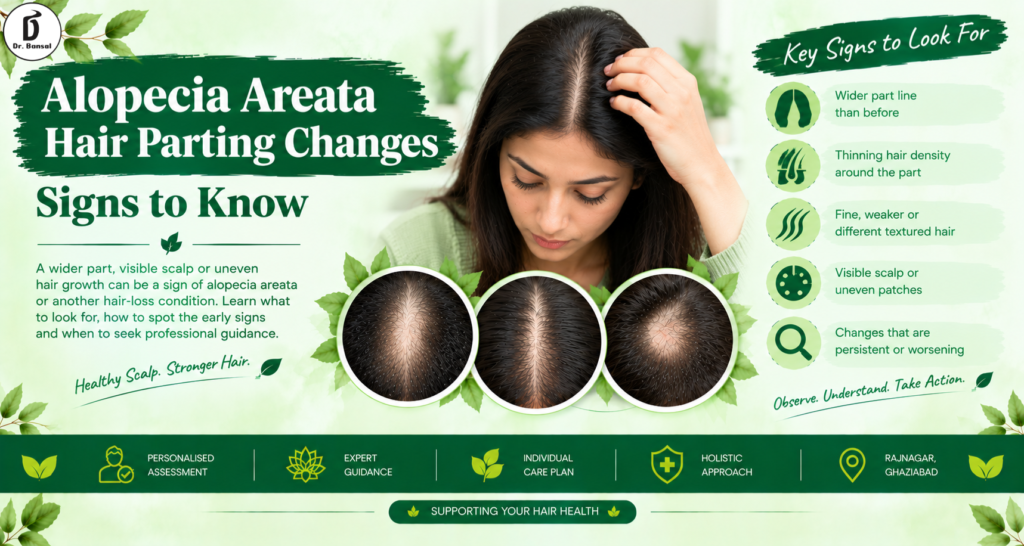
Possible Alopecia Areata Hair Parting Changes include:
- A previously even parting that appears interrupted by a small bald area.
- A visible patch extending from the parting towards the crown.
- An uneven-looking section where hair density has decreased.
- A new bald patch that becomes more noticeable when the hair is separated.
- Additional patches that alter how the hair naturally lies.
These changes are clues rather than a diagnosis. A professional assessment can help determine whether the pattern is consistent with alopecia areata or another cause of hair loss.
Why Does Your Scalp Suddenly Look More Visible?
There are several reasons your scalp may become easier to see. Understanding them can prevent unnecessary assumptions.
1. A patch of hair loss
Alopecia areata may create a smooth patch with clearly reduced hair. If the patch crosses your usual parting, the change can become noticeable quickly.
2. General thinning
Some conditions cause hair density to decrease gradually across a wider area. This may make the parting appear more prominent without producing a clearly defined bald patch.
3. Hair breakage
Short, broken strands may leave an area looking less dense. Tight hairstyles, friction and rough detangling can contribute to breakage.
4. Styling and lighting
Wet hair, oily strands, strong overhead lighting or a different parting direction can make more scalp visible temporarily.
If Alopecia Areata Hair Parting Changes persist across different hairstyles and lighting conditions, or you notice a distinct bald patch, consider arranging an assessment rather than relying on appearance alone.
How Can You Distinguish Alopecia Areata From Other Hair Concerns?
The pattern and speed of hair loss can offer useful clues.
With alopecia areata, hair loss commonly appears as smooth, defined patches. Some people notice a patch near the crown or parting, while others develop several affected areas.
General thinning usually affects a broader region, and hair breakage may leave strands of different lengths. Hair loss caused by repeated tension may be concentrated around areas where hairstyles pull on the roots.
Alopecia Areata Hair Parting Changes should therefore be considered alongside other signs, including sudden bald patches, eyebrow or eyelash changes, and the appearance of the scalp.
Persistent scaling, redness, tenderness or discomfort may point towards another scalp concern and should also be discussed with a professional.
What Should You Do When Your Hair Parting Changes?
If you notice Alopecia Areata Hair Parting Changes, begin by documenting what you see instead of repeatedly checking or pulling at the affected hair.
Take occasional photographs. Use similar lighting and angles so you can compare changes over time.
Record when the change began. Note whether it appeared suddenly, developed gradually or followed an earlier episode of hair loss.
Observe the pattern. Look for distinct patches, widespread thinning or short broken strands without repeatedly manipulating the area.
Use gentle hair-care practices. Avoid hairstyles that place excessive tension on the roots and detangle carefully.
Seek professional guidance. Arrange an assessment if the change persists, progresses or appears alongside new bald patches.
These steps can help you explain your concerns clearly, but they cannot independently establish the cause of hair loss.
Can Hair Grow Back Around the Parting?
Regrowth is possible when alopecia areata affects the scalp, but the course differs between individuals. Some people notice new strands appearing within affected patches, while others experience further hair loss or recurring episodes.
If Alopecia Areata Hair Parting Changes occur during regrowth, the hair may initially look fine, short or lighter than the surrounding strands. Its appearance can change as it grows, but no particular colour, texture or growth pattern guarantees recovery.
The visibility of the parting alone cannot tell you whether the condition has resolved. Monitoring the overall pattern and seeking appropriate follow-up is more useful than judging progress from one small area.
Why You Need to Visit Dr. Bansal Hair Rebirth Centre
Changes around the hair parting can have several explanations, and identifying the likely cause is more helpful than repeatedly changing hairstyles or hair-care products.
At Dr. Bansal Hair Rebirth Centre, you can discuss Alopecia Areata Hair Parting Changes, sudden bald patches, changes in hair density and concerns about regrowth. A personalised assessment can help clarify the possible cause and determine whether further evaluation or individual hair-care guidance may be appropriate.
Before your visit, note when the changes began, whether other areas are affected and whether you have experienced similar episodes before. Occasional photographs can also help document how the pattern has changed.
Contact Dr. Bansal Hair Rebirth Centre
- Address: MZL 07/08, Sumedha Tower, Ansal Building, Raj Nagar, Ghaziabad, Uttar Pradesh 201002
- Phone: +91-9953250910
- Website: https://drbansalhairrebirthcenter.in/
- Contact us. https://drbansalhairrebirthcenter.in/contact-us/.
Frequently Asked Questions
1. Can alopecia areata begin near the hair parting?
Yes. A patch can develop in different scalp locations, including an area close to the natural parting. However, a changed parting alone does not confirm alopecia areata.
2. Does a visible scalp line always mean hair loss?
No. Lighting, hair positioning and natural variation can change how much scalp is visible. Persistent changes in density deserve closer attention.
3. Can alopecia areata cause uneven hair growth?
Yes. Hair loss and regrowth can occur in separate areas, creating an uneven appearance. The pattern varies between individuals.
4. Should I change my hairstyle if I notice a bald patch?
You can choose a comfortable style that does not pull tightly on the roots, but changing your hairstyle will not identify or resolve every underlying cause of hair loss.
5. When should I seek an assessment?
Seek professional guidance if hair loss appears suddenly, a bald patch develops, the affected area grows or other hair-bearing areas become involved.
Conclusion
Alopecia Areata Hair Parting Changes may become noticeable when a patch develops near the natural parting or when hair density changes around the crown. However, styling, breakage and other conditions can produce similar appearances.
Pay attention to persistent changes, avoid excessive manipulation of the scalp and seek professional guidance when hair loss is sudden or progressing. Understanding the cause is the first step towards making informed decisions about your hair and scalp health.
Contact Details
Dr. Bansal Hair Rebirth Center
MZ-07/08, Sumedha Tower, RDC, Raj Nagar, Ghaziabad
Phone: +91 8595340077
Website: https://drbansalhairrebirthcenter.in/
know more about us – https://vedantamayurveda.in/