
Your hairline is one of the first places where changes in hair density may become noticeable. You might spot a small gap near your forehead, discover a smooth patch at one temple or notice that your hair looks different when you tie it back. These changes can be worrying, especially when they appear suddenly.
Thank you for reading this post, don't forget to subscribe!Understanding Alopecia Areata Hairline changes can help you recognise when hair loss deserves closer attention. Alopecia areata can affect different parts of the scalp, including areas close to the forehead and temples. However, not every receding or uneven hairline is caused by this condition.
This guide explains how alopecia areata may affect the hairline, which other conditions can look similar and when professional assessment may be useful.
What Is Alopecia Areata?
Alopecia areata is an immune-related condition in which the immune system mistakenly targets hair follicles and interrupts normal hair growth. It commonly causes smooth, round or oval patches of hair loss, although the size, number and location of patches can vary.
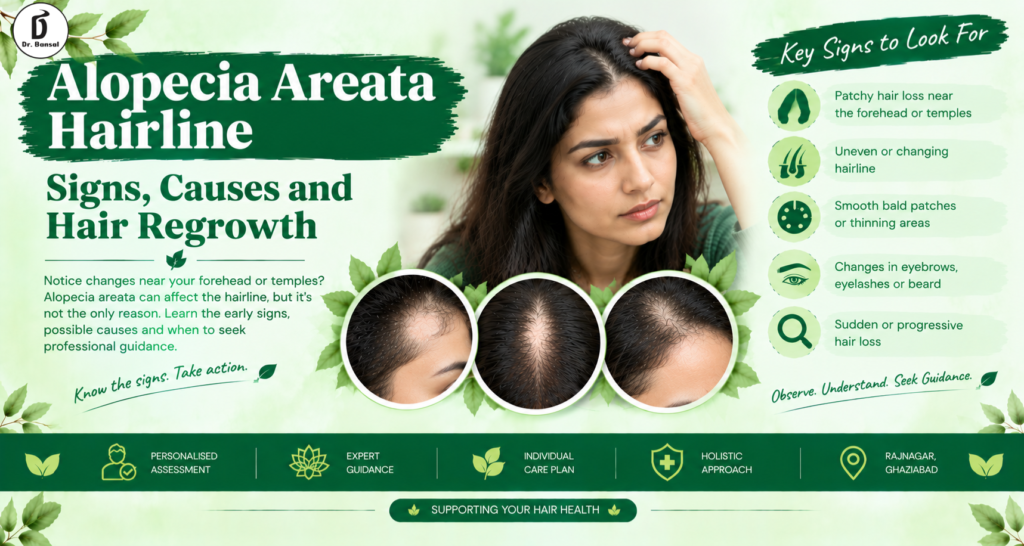
Alopecia Areata Hairline changes may occur when a patch develops near the forehead, temples or sides of the scalp. In some cases, the affected area becomes noticeable while styling the hair or looking closely at the hairline.
The condition does not always follow the same pattern. Some people experience one patch, while others develop several areas of hair loss. Hair may regrow in some areas even if another patch remains affected.
Can Alopecia Areata Affect the Hairline?
Yes. Alopecia areata can affect hair-bearing areas along the forehead and temples, although it does not always begin there.
Possible Alopecia Areata Hairline signs include:
- A clearly defined patch near the forehead.
- A smooth area with noticeably fewer hairs.
- A sudden gap near one temple.
- A patch that becomes larger over time.
- Additional bald areas elsewhere on the scalp.
- Hair loss involving eyebrows or other hair-bearing areas.
These signs are not enough to confirm a diagnosis. The location, appearance and progression of hair loss need to be considered together.
A hairline that gradually changes over several years may have a different explanation from a smooth bald patch that appears over a short period.
How Is Alopecia Areata Hairline Loss Different From a Receding Hairline?
A receding hairline and patchy hair loss can sometimes look similar, but their patterns often differ.
Alopecia areata: Hair loss may appear suddenly in a distinct, smooth patch. The surrounding hairline may remain unchanged, or other patches may develop elsewhere.
Pattern hair loss: The hairline may gradually move backwards, or the hair may become thinner across particular regions over time.
Traction-related hair loss: Repeated tension from tight hairstyles can affect the hairline, particularly around the temples and forehead.
Hair breakage: Short, broken strands may make the hairline look uneven without creating a completely bare patch.
When assessing Alopecia Areata Hairline changes, avoid relying only on how much forehead is visible. A professional can examine the distribution of missing hair and consider other possible causes.
What Causes Hair Loss Around the Hairline?
The cause depends on the pattern and the individual’s circumstances.
In alopecia areata, the immune system’s interaction with hair follicles is central to the condition. Its exact triggers are not always identifiable, and a person should not assume that a single stressful event, hairstyle or food caused the problem.
Other causes of Alopecia Areata Hairline-like changes include repeated pulling on the roots, gradual pattern thinning, hair breakage and certain scalp conditions.
Tight braids, ponytails or hairstyles that place persistent tension on the same areas may contribute to traction-related hair loss. Scalp irritation or scaling may also suggest that something other than alopecia areata needs to be considered.
Understanding the cause matters because different types of hair loss do not necessarily follow the same course.
Early Signs You Should Not Ignore
Changes near the hairline can be subtle at first. Pay attention if you notice:
- A new, smooth patch near the forehead or temple.
- A visible gap that was not present before.
- Hair loss that develops rapidly.
- Several distinct patches appearing on the scalp.
- Changes involving eyebrows, eyelashes or beard hair.
- Persistent redness, scaling, pain or itching.
These symptoms do not automatically mean alopecia areata. However, sudden or progressive hair loss deserves assessment, particularly when the scalp looks different from usual.
If you suspect Alopecia Areata Hairline loss, take occasional photographs under consistent lighting. This can help you document changes without repeatedly checking or pulling at the affected hair.
Can Hair Grow Back Along the Hairline?
Hair regrowth is possible when alopecia areata affects the hairline, but the outcome varies from person to person.
Some people notice fine strands returning within a previously bare patch. These hairs may initially appear lighter, shorter or softer than the surrounding hair. In other cases, regrowth may take longer, remain incomplete or be followed by another episode of hair loss.
The appearance of the hairline alone cannot predict the outcome. It is also important to distinguish regrowth from short, broken hairs caused by tension or damage.
There is no guaranteed timeline for Alopecia Areata Hairline recovery. A professional assessment can help you understand the observed pattern and discuss realistic expectations.
How to Care for Your Hairline
While investigating the cause of hair loss, gentle handling can help reduce avoidable damage.
- Choose hairstyles that do not pull tightly on the forehead or temples.
- Avoid repeatedly brushing or rubbing the affected area.
- Detangle carefully, especially when hair is wet.
- Keep track of changes without pulling at individual strands.
- Maintain balanced daily habits and a comfortable scalp-care routine.
- Seek guidance if new patches appear or hair loss continues.
These habits may help limit mechanical breakage, but they cannot guarantee recovery from alopecia areata. The most important step is understanding why the hairline has changed.
Why You Need to Visit Dr. Bansal Hair Rebirth Centre
Changes around the forehead and temples can have several explanations, so identifying the likely cause is more useful than making assumptions based on appearance.
At Dr. Bansal Hair Rebirth Centre, you can discuss Alopecia Areata Hairline changes, sudden bald patches, gradual thinning and concerns about regrowth. An individual assessment can help clarify the possible cause and determine whether further evaluation or personalised hair-care guidance may be appropriate.
Before your visit, note when the change began, whether the patch has grown and whether other areas are affected. Occasional photographs may also help document the progression.
Contact Dr. Bansal Hair Rebirth Centre
- Address: MZL 07/08, Sumedha Tower, Ansal Building, Raj Nagar, Ghaziabad, Uttar Pradesh 201002
- Phone: +91-9953250910
- Website: https://drbansalhairrebirthcenter.in/
- Contact us. https://drbansalhairrebirthcenter.in/contact-us/.
Frequently Asked Questions
1. Can alopecia areata start at the front of the scalp?
Yes. Alopecia areata can affect different scalp areas, including the hairline, although it does not always begin there.
2. Does an uneven hairline mean alopecia areata?
No. Hair breakage, repeated tension and other hair-loss conditions can also affect the hairline. Assessment is needed to identify the likely cause.
3. Can alopecia areata affect the temples?
Yes. Patches can occur near the temples and forehead, and additional areas may be affected in some individuals.
4. Will hair grow back on the affected hairline?
Regrowth is possible, but it varies. No particular recovery timeline or result can be guaranteed.
5. When should I seek professional guidance?
Consider an assessment if you notice sudden bald patches, progressive hair loss, new affected areas or persistent scalp symptoms.
Conclusion
Alopecia Areata Hairline changes may appear as smooth patches near the forehead or temples, but other conditions can create similar signs. The speed of change, pattern of missing hair and appearance of the scalp all help provide context.
Avoid assuming that every uneven hairline is alopecia areata. If you notice sudden or continuing hair loss, seek professional guidance to understand the cause and make informed decisions about your scalp and hair care.
Contact Details
Dr. Bansal Hair Rebirth Center
MZ-07/08, Sumedha Tower, RDC, Raj Nagar, Ghaziabad
Phone: +91 8595340077
Website: https://drbansalhairrebirthcenter.in/
know more about us – https://vedantamayurveda.in/