Discovering a bald patch can be frightening, especially when the affected area looks smooth and has very little visible hair. One of the first questions people ask is whether the hair will ever grow back or whether the follicles have been permanently damaged.
Thank you for reading this post, don't forget to subscribe!Understanding Non-Scarring Hair Loss can help answer this concern. Alopecia areata is generally classified as a non-scarring form of hair loss, meaning that the hair follicles are usually preserved even when visible hair disappears.
However, not every smooth bald patch has the same cause. Some conditions can permanently damage hair follicles, making early assessment important. This guide explains the difference, the signs to observe and when to seek professional guidance.
What Is Non-Scarring Hair Loss?
Non-Scarring Hair Loss describes hair loss in which the hair follicles are not permanently destroyed. Hair may stop growing or fall out, but the structures responsible for producing hair generally remain present.
This is an important distinction because preserved follicles may retain the ability to produce new hair, depending on the underlying condition.
Alopecia areata is a common example. It is an immune-related condition in which the immune system mistakenly targets hair follicles and interrupts normal hair growth.
The affected area may look completely smooth, but smooth skin does not automatically mean that the follicles have disappeared.
Is Alopecia Areata a Non-Scarring Condition?
Yes. Alopecia areata is generally considered Non-Scarring Hair Loss because it usually does not destroy the hair follicles.
It commonly appears as one or more round or oval patches on the scalp. The skin inside these patches often looks relatively normal, without permanent scarring.
Some people experience only one small patch, while others develop several areas of hair loss. In more extensive cases, eyebrows, eyelashes, beard hair and other body hair may also be affected.
Although the follicles are generally preserved, this does not guarantee that hair will regrow immediately or that the condition will never return. The course varies from person to person.
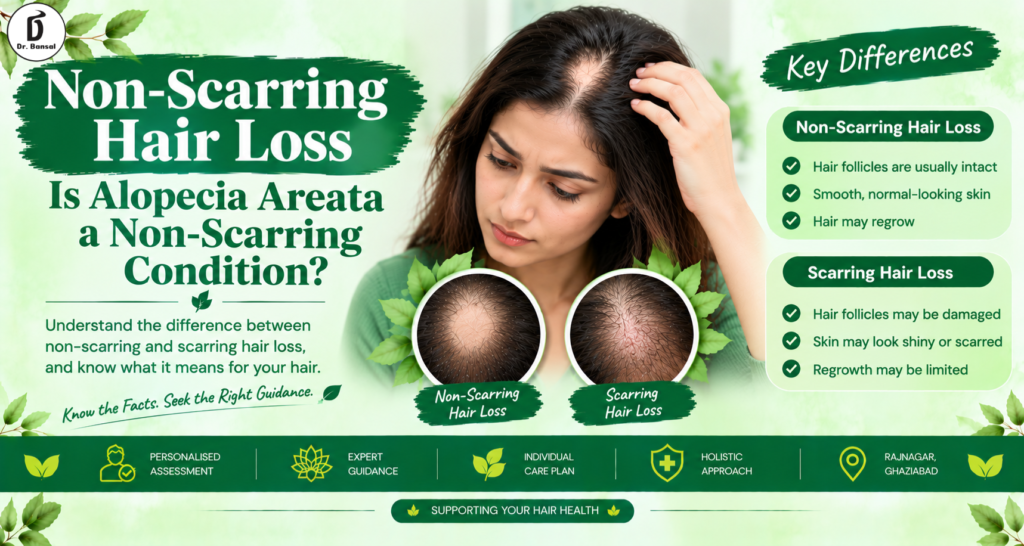
What Is the Difference Between Scarring and Non-Scarring Hair Loss?
Understanding the difference between these two categories is essential when evaluating a bald patch.
1. Non-scarring hair loss
In Non-Scarring Hair Loss, the follicles generally remain intact. Hair may disappear from an area, but the skin does not necessarily show permanent follicular damage.
Possible characteristics include:
- Smooth or relatively normal-looking skin.
- Visible patches without obvious scars.
- Hair loss that may occur suddenly.
- Possible regrowth in affected areas.
- Changes in the number or size of patches over time.
Alopecia areata belongs to this category.
2. Scarring hair loss
Scarring hair loss occurs when inflammation or another damaging process destroys hair follicles and replaces them with scar tissue.
Possible warning signs include:
- Shiny or unusually smooth areas of skin.
- Persistent redness or inflammation.
- Scaling around hair follicles.
- Pain, tenderness or burning sensations.
- Gradual loss of visible follicular openings.
These signs do not confirm scarring hair loss by themselves, but they deserve professional attention.
The distinction matters because permanently damaged follicles may not produce new hair in the same way as follicles affected by Non-Scarring Hair Loss.
Can Hair Grow Back After Non-Scarring Hair Loss?
Hair regrowth is possible in many forms of Non-Scarring Hair Loss, including alopecia areata. However, the outcome depends on the underlying cause and individual circumstances.
With alopecia areata, some people notice fine new hairs appearing inside previously affected patches. These hairs may initially look lighter, shorter or thinner than the surrounding strands.
Others may experience slower regrowth, incomplete coverage or recurring episodes of hair loss.
It is important to remember that preserved follicles provide the possibility of regrowth, not a guarantee. There is no fixed recovery timeline that applies to everyone.
How Can You Recognise Possible Follicle Damage?
The appearance of the scalp can provide useful clues, although it cannot establish a diagnosis on its own.
If you notice a bald patch, pay attention to:
Skin appearance: Does the affected area look similar to the surrounding scalp, or does it appear shiny, inflamed or unusually smooth?
Follicular openings: Are tiny openings where hairs normally emerge still visible? Their absence may deserve further investigation.
Scalp sensations: Is there persistent itching, tenderness, burning or discomfort?
Progression: Is the patch appearing suddenly, gradually expanding or accompanied by additional areas?
A professional examination can help distinguish Non-Scarring Hair Loss from conditions that may involve permanent follicular damage.
What Should You Do If You Discover a Smooth Bald Patch?
First, avoid assuming that a smooth patch means permanent hair loss. Alopecia areata can create smooth-looking areas while leaving the follicles preserved.
Consider these practical steps:
- Take a clear photograph of the affected area.
- Note when you first noticed the patch.
- Observe whether its size or shape changes.
- Check whether other areas of the scalp or body are affected.
- Avoid repeatedly pulling or rubbing the affected hair.
- Arrange a professional assessment to understand the possible cause.
These observations can help explain your concerns during a consultation. They should not replace an examination, particularly if the skin looks inflamed or changes rapidly.
Why You Need to Visit Dr. Bansal Hair Rebirth Centre
Understanding whether your condition involves Non-Scarring Hair Loss or possible follicular damage is an important step towards making informed decisions about your hair health.
At Dr. Bansal Hair Rebirth Centre, you can discuss alopecia areata, sudden bald patches, changes in scalp appearance and concerns about hair regrowth. The centre focuses on personalised hair and scalp assessment to understand individual patterns of hair loss.
An assessment can help clarify the possible cause and whether further evaluation or individual hair-care guidance may be appropriate.
Contact Dr. Bansal Hair Rebirth Centre
- Address: MZL 07/08, Sumedha Tower, Ansal Building, Raj Nagar, Ghaziabad, Uttar Pradesh 201002
- Phone: +91-9953250910
- Website: https://drbansalhairrebirthcenter.in/
- Contact us. https://drbansalhairrebirthcenter.in/contact-us/.
Frequently Asked Questions
1. Is alopecia areata permanent hair loss?
Not necessarily. Alopecia areata is generally non-scarring, and regrowth is possible. However, its course varies between individuals.
2. Does smooth skin mean hair follicles are destroyed?
No. Alopecia areata can create smooth bald patches while leaving the follicles preserved.
3. Can non-scarring hair loss become scarring hair loss?
They are different categories of hair loss. However, another scalp condition can sometimes be mistaken for alopecia areata, which is why an accurate assessment matters.
4. Can hair regrow after non-scarring hair loss?
Yes, depending on the underlying condition. Preserved follicles may continue producing hair, although regrowth is not guaranteed.
5. When should I seek professional guidance?
Seek an assessment if you notice sudden bald patches, persistent scalp inflammation, shiny areas, tenderness or progressive hair loss.
Conclusion
Non-Scarring Hair Loss is an important concept for anyone experiencing sudden bald patches. Alopecia areata generally belongs to this category because it usually affects hair growth without permanently destroying the follicles.
However, other conditions can also cause bald patches, and some may involve permanent follicular damage. Paying attention to scalp changes and seeking professional guidance can help you understand what is happening rather than relying on appearance alone.
Contact Details
Dr. Bansal Hair Rebirth Center
MZ-07/08, Sumedha Tower, RDC, Raj Nagar, Ghaziabad
Phone: +91 8595340077
Website: https://drbansalhairrebirthcenter.in/
know more about us – https://vedantamayurveda.in/