Living with unexpected hair loss can leave you wondering whether your condition is improving, staying the same or becoming more active. One week, a bald patch may look unchanged; a few weeks later, you might notice tiny hairs appearing around its edges. These small differences can be difficult to interpret.
Thank you for reading this post, don't forget to subscribe!Understanding Alopecia Areata Progress is about observing changes over time rather than judging your hair condition by one day’s appearance. Alopecia areata can follow different patterns, and regrowth does not always happen at the same speed for everyone.
This guide explains how to monitor your scalp, recognise possible signs of regrowth, identify changes worth discussing with a professional and maintain realistic expectations.
Why Is Monitoring Alopecia Areata Progress Important?
Alopecia areata is an immune-related condition in which the immune system mistakenly targets hair follicles. It commonly causes smooth, round or oval patches of hair loss. Some people experience one patch, while others develop multiple affected areas.
Monitoring Alopecia Areata Progress can help you understand how the affected areas change over time. It may also help you notice whether new patches are appearing or whether previously affected areas are showing signs of hair growth.
Without a consistent record, it is easy to misjudge changes because hair can look different depending on lighting, hairstyle, length and camera angle.
Remember that observing changes does not replace professional evaluation. It simply gives you clearer information to discuss during a consultation.
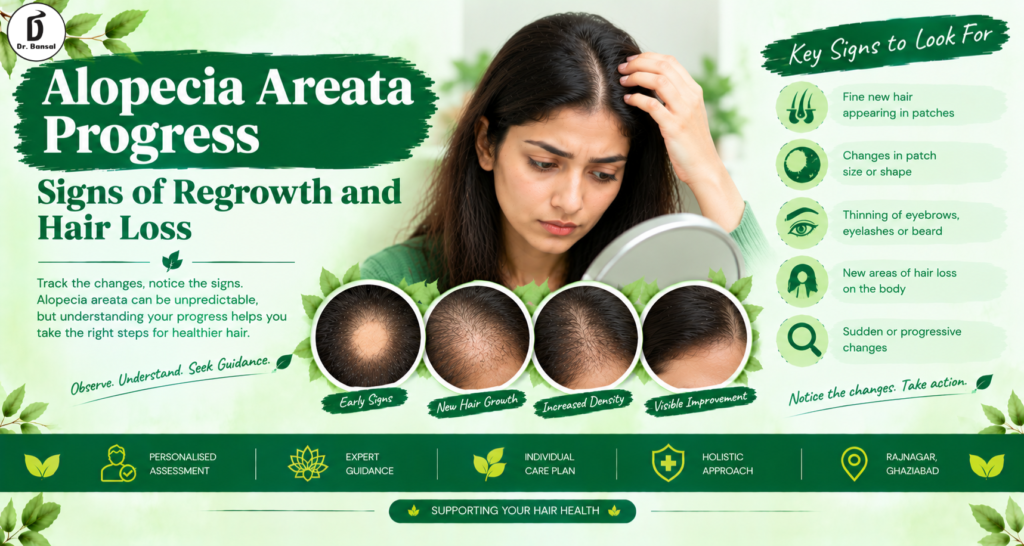
Five Signs That May Indicate Hair Regrowth
Regrowth can look different from the surrounding hair at first. The following changes may be worth documenting.
1. Fine New Hair Appearing
One possible sign of Alopecia Areata Progress is the appearance of tiny, fine hairs within a previously affected patch. These strands may initially look softer or thinner than the surrounding hair.
Their presence can be encouraging, but it does not guarantee that the area will continue to fill in at a particular speed.
2. Changes in Patch Appearance
A previously smooth-looking patch may begin to show small areas of new growth. The change may be subtle, so comparing photographs taken several weeks apart can be more useful than checking the scalp every day.
3. Gradual Increase in Hair Coverage
Some people notice that more of the affected area becomes covered over time. However, regrowth may be uneven, with some sections changing before others.
4. Changes in Hair Texture or Colour
New hair may initially appear lighter, finer or different in texture. Its appearance can change as it grows, so avoid assuming that a different colour means something is wrong.
5. Previously Affected Areas Looking Different
A patch may gradually become less noticeable as hair returns. Keep in mind that the appearance of one area does not necessarily tell you what is happening elsewhere on the scalp.
Signs That Alopecia Areata May Be Becoming More Active
Monitoring Alopecia Areata Progress also means paying attention to changes that may indicate continuing hair loss.
Look out for:
- A previously small bald patch becoming larger.
- New smooth patches appearing elsewhere.
- Hair loss involving eyebrows, eyelashes or beard hair.
- Changes in several scalp areas over a short period.
- New areas of reduced hair density.
These observations do not establish how the condition will develop. Alopecia areata can be unpredictable, and a new patch does not automatically mean that extensive hair loss will follow.
If you notice sudden or continuing changes, arrange a professional assessment rather than relying only on photographs or online comparisons.
How to Track Alopecia Areata Progress at Home
A simple monitoring routine can help you understand changes without constantly checking your hair.
Take photographs consistently. Photograph the affected areas every few weeks using similar lighting, distance and angles. Avoid comparing pictures taken under very different conditions.
Record the date. Note when you first noticed a patch and when you took each photograph.
Keep track of affected areas. Record whether the scalp, eyebrows, eyelashes or beard are involved.
Write down noticeable changes. Mention whether a patch looks larger, smaller or appears to have new hair.
Avoid repeated hair pulling. Pulling strands to test whether they are loose can cause unnecessary breakage and make monitoring confusing.
A short record is often more useful than checking your reflection several times every day.
Why Does Alopecia Areata Progress Differ Between People?
There is no single timeline that applies to everyone. Some people experience limited patches that remain stable, while others notice new areas of hair loss or repeated episodes.
Factors such as individual immune responses, the extent of hair loss and the overall course of the condition can influence what happens next. A person’s experience cannot reliably predict another person’s outcome.
This is why Alopecia Areata Progress should be assessed individually. Avoid comparing your regrowth with another person’s photographs or expecting your hair to follow a fixed schedule.
Common Mistakes to Avoid While Monitoring Hair Loss
When you are concerned about your hair, it is natural to look for signs of improvement. However, certain habits can make the experience more stressful or create misleading impressions.
- Do not compare your hair with photographs taken in different lighting.
- Do not assume that one new strand confirms complete recovery.
- Do not treat every loose hair as evidence that the condition is worsening.
- Avoid repeatedly touching or pulling affected areas.
- Do not rely on online photographs to diagnose your own condition.
- Avoid expecting a guaranteed regrowth timeline.
The purpose of tracking Alopecia Areata Progress is to understand changes calmly and share useful information with a professional.
Why You Need to Visit Dr. Bansal Hair Rebirth Centre
If you are unsure whether your hair is regrowing or new patches are developing, a professional assessment can help you understand the pattern more clearly.
Dr. Bansal Hair Rebirth Centre focuses on alopecia and hair-loss concerns, including alopecia areata. You can discuss your hair-loss history, changes in affected areas and observations from your photographs. An individual assessment can help clarify what further evaluation or personalised hair-care guidance may be appropriate.
The centre is located in Raj Nagar, Ghaziabad, and provides an opportunity to discuss your concerns in a focused consultation.
Contact Dr. Bansal Hair Rebirth Centre
- Address: MZL 07/08, Sumedha Tower, Ansal Building, Raj Nagar, Ghaziabad, Uttar Pradesh 201002
- Phone: +91-9953250910
- Website: https://drbansalhairrebirthcenter.in/
- Contact us. https://drbansalhairrebirthcenter.in/contact-us/.
Frequently Asked Questions
1. How often should I check my alopecia areata patches?
Taking photographs every few weeks under similar conditions can help you compare changes without repeatedly checking your scalp.
2. Does new hair always mean alopecia areata is improving?
New hair may be an encouraging sign, but it does not guarantee that the condition has become inactive or that regrowth will continue.
3. Can alopecia areata become active again after regrowth?
Yes. Hair loss can recur in some people, even after previously affected areas have shown regrowth.
4. How long does hair regrowth take?
There is no universal timeline. Regrowth varies depending on the individual and the course of the condition.
5. Should I visit a specialist if a new patch appears?
Yes. A new or expanding bald patch deserves professional assessment to understand its possible cause.
Conclusion
Understanding Alopecia Areata Progress takes patience and consistent observation. Fine new hairs, changes in patch appearance and additional areas of hair loss can all provide useful information about how your condition is changing.
Use occasional photographs, maintain a simple record and avoid judging progress from one day’s appearance. Most importantly, remember that every person’s experience is different. Professional guidance can help you interpret changes and make informed decisions about your hair and scalp health.
Contact Details
Dr. Bansal Hair Rebirth Center
MZ-07/08, Sumedha Tower, RDC, Raj Nagar, Ghaziabad
Phone: +91 8595340077
Website: https://drbansalhairrebirthcenter.in/
know more about us – https://vedantamayurveda.in/