
Seeing your hair grow back after experiencing alopecia areata can bring relief and renewed confidence. However, some people notice new bald patches even after the earlier areas have started filling in. This experience can be confusing, especially when it seems that the problem has finally settled.
Thank you for reading this post, don't forget to subscribe!An Alopecia Areata Relapse occurs when hair loss returns after a period of improvement or regrowth. It does not necessarily mean that you have done something wrong or that your hair will continue falling out forever. Alopecia areata can follow different patterns in different people, making it important to understand the condition and recognise changes early.
In this guide, we explain why hair loss may return, which signs to watch for, and how professional assessment can help you make informed decisions about your hair health.
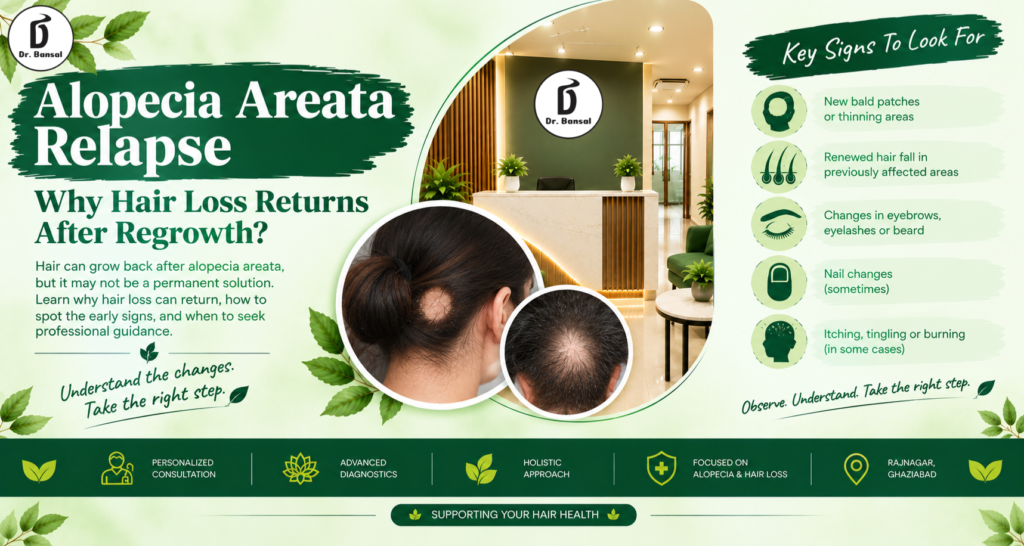
What Is an Alopecia Areata Relapse?
Alopecia areata is a condition in which the immune system mistakenly targets hair follicles, leading to hair loss. It commonly appears as smooth, round or oval patches on the scalp, although the eyebrows, eyelashes, beard, and other hair-bearing areas can also be affected.
During recovery, hair may gradually grow back in previously affected areas. However, regrowth does not always mean that the condition has permanently stopped. An Alopecia Areata Relapse can involve new patches, renewed shedding in an earlier area, or changes in the overall pattern of hair loss.
Some people experience only one episode, while others have repeated periods of hair loss and regrowth. The timing and severity of a relapse cannot be predicted accurately for every individual.
Why Can Hair Loss Return After Regrowth?
There is no single explanation for every Alopecia Areata Relapse. Several factors may be relevant, and sometimes no clear trigger can be identified.
1. The condition can follow an unpredictable course
Alopecia areata does not always progress in a straight line. Hair may regrow in one area while another patch appears elsewhere. In some cases, improvement lasts for a long time before another episode occurs.
This unpredictable pattern is one reason why monitoring changes matters, even when your scalp appears to be recovering.
2. Family history may play a role
Genetic factors can influence a person’s likelihood of developing alopecia areata. If close relatives have experienced the condition, it may be useful to mention this during an assessment. However, having a family history does not mean that a relapse is inevitable.
3. Stress and major life changes
Physical or emotional stress may be associated with changes in hair shedding, and some people report noticing hair loss after a difficult period. Nevertheless, stress is not the only explanation for an Alopecia Areata Relapse, and many episodes occur without an identifiable stressful event.
It is important not to blame yourself. Experiencing stress does not mean you caused your condition.
4. Other health factors may need consideration
Not every new patch or increase in shedding is caused by alopecia areata. Nutritional deficiencies, hormonal changes, illness-related shedding, scalp conditions, and other causes of hair loss can produce different patterns.
A professional assessment can help distinguish a possible relapse from a separate hair or scalp concern.
Early Signs of an Alopecia Areata Relapse
Recognising changes early can help you seek appropriate guidance. Look for the following signs:
- New bald patches: Smooth areas appear on the scalp or other hair-bearing parts of the body.
- Changes in previous patches: Hair begins thinning again in an area where regrowth had occurred.
- Increased scalp visibility: A particular region appears less dense than it did previously.
- Eyebrow or beard changes: Small areas of missing hair appear outside the scalp.
- Scalp sensations: Some people experience itching, tingling, or burning before or around an affected area, although these sensations are not specific to alopecia areata.
- Nail changes: Small dents or an unusual surface texture may sometimes accompany the condition.
These signs alone cannot confirm an Alopecia Areata Relapse. If you notice sudden or progressive changes, seek professional advice rather than relying on photographs or online comparisons to diagnose yourself.
What Should You Do If Hair Loss Returns?
If you suspect an Alopecia Areata Relapse, start by recording when you first noticed the changes. Occasional photographs taken under similar lighting can help you compare visible patterns over time.
Handle your hair gently and avoid excessive pulling, rough brushing, or tight hairstyles that place unnecessary tension on the hair. Maintain balanced meals, adequate sleep, and regular daily routines to support general health.
Remember that these habits cannot guarantee hair regrowth or prevent another episode. Alopecia areata involves immune-related processes, so ordinary hair-care practices alone may not address the underlying condition.
Arrange an assessment if new patches appear, earlier areas begin thinning again, or the hair loss spreads. A professional may examine your scalp and nails, review your history, and consider whether further evaluation is needed.
How Can You Manage the Emotional Impact?
An Alopecia Areata Relapse can affect more than your appearance. You may feel frustrated, anxious, or disappointed when hair begins falling out again after a period of hope.
Give yourself permission to acknowledge those feelings without judging yourself. You do not need to hide your concerns or pretend that the experience is easy.
Talking to trusted family members or friends can provide support. If hair loss affects your confidence, school, work, or everyday activities, discussing these concerns with a suitable professional may also help.
Hair regrowth is not a measure of your personal worth. Everyone’s experience with alopecia areata is different, and uncertainty about the condition does not mean you have failed.
Why You Need to Visit Dr. Bansal Hair Rebirth Centre
If you are concerned about an Alopecia Areata Relapse, understanding your individual hair-loss pattern is an important first step. At Dr. Bansal Hair Rebirth Centre, the focus is on personalised hair and scalp assessment and understanding the concerns associated with alopecia and other forms of hair loss.
A consultation can help you discuss when the hair loss started, whether earlier patches have changed, and whether other areas are now affected. The appropriate next steps depend on your individual findings and may involve further assessment when necessary.
The centre aims to provide guidance tailored to each person’s concerns rather than assuming that every case follows the same pattern. Although no centre can guarantee that alopecia areata will never return, understanding your condition can help you make more informed decisions about your hair health.
Contact Dr. Bansal Hair Rebirth Centre:
- Address: MZL 07/08, Sumedha Tower, Ansal Building, Raj Nagar, Ghaziabad, Uttar Pradesh 201002
- Phone: +91-9953250910
- Website: https://drbansalhairrebirthcenter.in/
- Contact us. https://drbansalhairrebirthcenter.in/contact-us/.
Frequently Asked Questions
1. Can alopecia areata return after complete regrowth?
Yes. Some people experience another episode after their hair has regrown. Others may not experience another episode. The course varies from person to person.
2. Does a relapse mean that hair will never grow back?
No. A relapse does not automatically mean permanent hair loss. Future regrowth is variable, and the outcome cannot be predicted from one episode alone.
3. Can stress alone cause an alopecia areata relapse?
Stress may be relevant for some people, but it is not the sole explanation for every relapse. Sometimes no clear trigger can be identified.
4. How can I tell if hair loss has returned?
New smooth patches, renewed thinning in previously affected areas, or hair loss in the eyebrows or beard may be clues. An assessment is needed to establish the cause.
5. When should I seek professional guidance?
Seek guidance when new patches appear, hair loss progresses quickly, or the pattern changes unexpectedly. Early assessment can help clarify what may be happening.
Conclusion
An Alopecia Areata Relapse can feel discouraging, particularly after you have noticed encouraging regrowth. However, recurring hair loss does not mean that you caused the problem or that the outcome is predetermined.
Pay attention to new changes, care for your hair gently, and seek professional guidance when needed. Understanding the pattern of your hair loss is an important step towards managing your concerns with greater clarity and confidence.
Contact Details
Dr. Bansal Hair Rebirth Center
MZ-07/08, Sumedha Tower, RDC, Raj Nagar, Ghaziabad
Phone: +91 8595340077
Website: https://drbansalhairrebirthcenter.in/
know more about us – https://vedantamayurveda.in/