
Hair loss is usually associated with adults, but Gen Alpha Hair Loss can also become a concern during childhood. When parents suddenly notice a bald patch, excessive shedding, broken hairs, or thinning areas, it is natural to worry about alopecia areata. However, not every case of Gen Alpha Hair Loss is caused by alopecia.
Thank you for reading this post, don't forget to subscribe!Children can experience hair loss for several different reasons. Understanding the pattern of hair loss is therefore an important first step before assuming that a child has alopecia areata.
Thank you for visiting Dr. Bansal Hair Rebirth Centre! 🙏
We’d love to hear about your genuine experience with us.
⭐ Share your feedback on Google:
https://g.page/r/CRdQZHexAiWNEAE/review
Your feedback helps us improve our patient experience. ❤️
Why Does Gen Alpha Hair Loss Happen?
Gen Alpha Hair Loss can have different causes depending on the child’s age, health, scalp condition, hair-care habits, and individual circumstances.
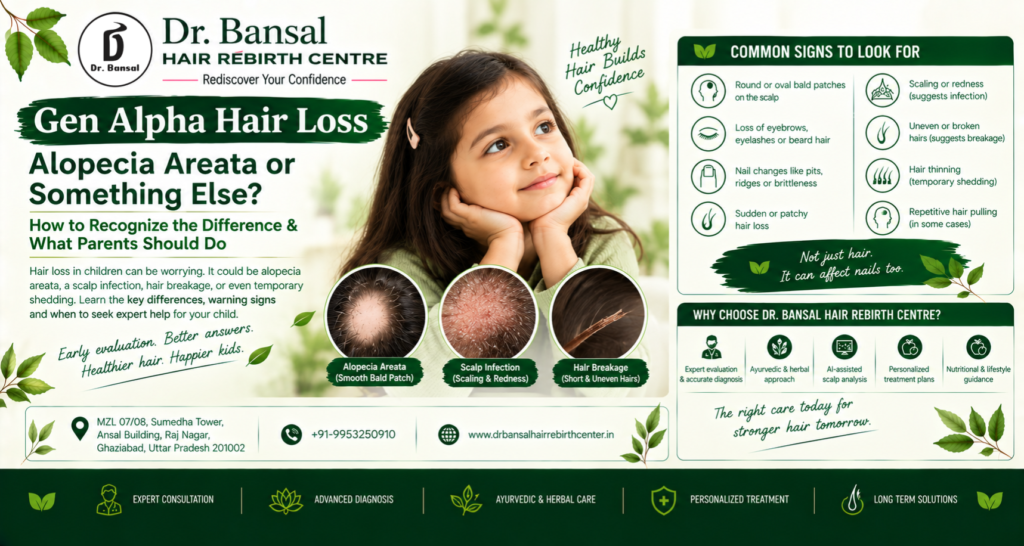
Alopecia areata is one possible cause. It is an immune-mediated condition that commonly produces sudden, smooth, round or oval patches of hair loss. It can also affect eyebrows, eyelashes and other body hair.
However, other childhood conditions can also produce noticeable Gen Alpha Hair Loss. These may include scalp infections, hair-pulling behaviours, physical damage to the hair shaft, temporary shedding after illness, and other scalp or medical conditions.
That is why identifying the pattern matters.
Gen Alpha Hair Loss From Alopecia Areata
One of the most recognizable patterns of Gen Alpha Hair Loss associated with alopecia areata is a smooth bald patch.
The skin within the patch may look relatively normal, without obvious scaling or inflammation. The patch can be round or oval and may appear suddenly. Some children develop one patch, while others develop several.
Alopecia areata can also affect eyebrows and eyelashes. Nail changes can occur in some people as well.
If a child develops this type of Gen Alpha Hair Loss, parents should avoid assuming that it is simply caused by shampoo, poor nutrition, or everyday stress.
A professional evaluation can help determine what is actually happening.
Gen Alpha Hair Loss From Scalp Infection
Another possible cause of Gen Alpha Hair Loss is a fungal scalp infection, commonly known as tinea capitis.
Unlike the smooth appearance often associated with alopecia areata, an infected scalp may have scaling, irritation, broken hairs, crusting or other visible changes. Some children may also experience itching.
This difference can be useful when looking at Gen Alpha Hair Loss, but appearance alone cannot reliably establish a diagnosis.
A child with suspected scalp infection needs appropriate medical assessment because infections may require specific treatment.
Gen Alpha Hair Loss From Hair Pulling
Some children may repeatedly pull, twist or manipulate their hair. Over time, this can cause areas of uneven hair loss or breakage.
Hair-pulling-related Gen Alpha Hair Loss can look different from a classic alopecia areata patch because hairs may be broken at different lengths rather than completely absent from a smooth area.
Parents should approach this subject calmly. Blaming, shaming or repeatedly drawing attention to the child’s hair can make the situation more difficult.
If hair pulling appears repetitive or difficult for the child to control, discussing it with an appropriate healthcare professional can be helpful.
Gen Alpha Hair Loss After Illness
Children may sometimes experience increased hair shedding after an illness or another physical stress on the body. This type of Gen Alpha Hair Loss may look different from a clearly defined bald patch.
Instead of one smooth area, parents may notice more hair than usual on a pillow, in the bath, or while brushing.
Temporary shedding and alopecia areata are not the same condition, so the timing and pattern of the hair loss are important.
If shedding continues, becomes significant, or is accompanied by bald patches, a professional assessment can help identify the cause.
Does Hair Breakage Mean Alopecia?
Not necessarily.
Hair breakage can create the appearance of Gen Alpha Hair Loss even when the follicles themselves are still producing hair.
Frequent tight hairstyles, excessive pulling, rough handling, heat, chemical treatments, or repeated friction can contribute to hair damage.
Parents can look for differences in hair length and broken strands rather than assuming that every area of reduced hair density represents alopecia.
If the cause is unclear, however, it is better to have the child’s scalp and hair examined rather than trying multiple products at home.
When Should Parents Take Gen Alpha Hair Loss Seriously?
Not every episode of Gen Alpha Hair Loss means there is a serious underlying problem. However, parents should consider professional evaluation when:
- Hair loss appears suddenly.
- A smooth bald patch develops.
- Several new patches appear.
- Eyebrows or eyelashes begin thinning.
- Hair loss continues or becomes more extensive.
- The scalp becomes itchy, scaly, painful or inflamed.
- There are noticeable nail changes.
- Hair pulling or repetitive hair manipulation is suspected.
- The child is becoming worried or distressed about the change.
The American Academy of Dermatology explains that alopecia areata can often be diagnosed through examination of the affected hair and nails, medical history, and sometimes dermatoscopy or additional testing.
How Is Gen Alpha Hair Loss Diagnosed?
Diagnosing Gen Alpha Hair Loss starts with understanding what the parent and child have noticed.
A healthcare professional may ask when the hair loss began, how quickly it developed, whether it has happened before, whether there is a family history of alopecia, and whether other symptoms are present.
The scalp and nails may be examined closely. A dermatoscope can provide additional information about the scalp and hair follicles. In selected situations, blood testing or other investigations may be considered.
This approach is important because treatment should depend on the actual cause of Gen Alpha Hair Loss.
Is Alopecia Treatment the Same for Every Child?
No. Treatment for Gen Alpha Hair Loss depends on the diagnosis.
The AAD notes that children can require different treatment considerations from adults. For some children with limited alopecia areata, hair may regrow without treatment. When treatment is appropriate, the options depend on factors including age, amount of hair loss, location and duration.
Parents should therefore avoid giving children prescription medicines, strong scalp treatments, or adult hair-growth products without appropriate professional guidance.
The goal should be to understand the cause first and then choose age-appropriate care.
Why You Need to Visit Dr. Bansal Hair Rebirth Centre
If your child is experiencing unexplained Gen Alpha Hair Loss, a professional consultation can help distinguish alopecia from other possible causes.
Dr. Bansal Hair Rebirth Centre in Ghaziabad states that it specializes in alopecia areata, alopecia totalis, alopecia universalis, hair fall, hair thinning and other hair and scalp concerns. The centre also describes personalized hair and scalp assessment and technology-assisted scalp analysis.
For Gen Alpha Hair Loss, involving a parent or guardian throughout the consultation is particularly important. The focus should be on understanding the child’s condition, considering appropriate options, and avoiding unnecessary experimentation with hair products.
Dr. Bansal Hair Rebirth Centre is located at MZL 07/08, Sumedha Tower, Ansal Building, Raj Nagar, Ghaziabad, Uttar Pradesh 201002. The centre lists +91-9953250910 as its contact number.
Contact us. https://drbansalhairrebirthcenter.in/contact-us/.
Frequently Asked Questions
Is every case of Gen Alpha Hair Loss alopecia areata?
No. Gen Alpha Hair Loss can have several causes, including alopecia areata, scalp infections, hair pulling, breakage and temporary shedding.
How can parents recognize alopecia areata?
A sudden smooth, round or oval bald patch is a common pattern. However, only an appropriate professional assessment can determine whether the hair loss is actually alopecia areata.
Can children recover from alopecia areata?
Hair can regrow in children with alopecia areata, sometimes without treatment, but the course varies between individuals and recurrence can occur.
Should parents immediately change their child’s shampoo?
Not necessarily. If Gen Alpha Hair Loss is sudden or unexplained, identifying the cause is more useful than repeatedly changing hair products.
When should a child see a professional?
Sudden bald patches, rapidly increasing hair loss, recurring episodes, eyebrow or eyelash loss, scalp abnormalities, or persistent shedding are reasonable reasons to seek professional evaluation.
Final Thoughts
Gen Alpha Hair Loss can be worrying, but the first visible sign does not automatically tell you the cause. Alopecia areata is one possibility, but scalp infections, hair pulling, breakage and temporary shedding can also produce noticeable changes.
The most important step is to pay attention to the pattern and seek appropriate evaluation when the cause is unclear. Avoid blaming the child or assuming that hair loss is simply the result of poor hair care.
With the right assessment and age-appropriate guidance, families can make more informed decisions about Gen Alpha Hair Loss and their child’s overall hair and scalp health.
Contact Details
Dr. Bansal Hair Rebirth Center
MZ-07/08, Sumedha Tower, RDC, Raj Nagar, Ghaziabad
Phone: +91 8595340077
Website: https://drbansalhairrebirthcenter.in/
know more about us – https://vedantamayurveda.in/