
Hair loss can become more noticeable with age, but hair loss after 40 should not automatically be dismissed as a normal part of getting older. Changes in hormones, genetics, nutrition, illness, medications, stress, and scalp health can all contribute to thinning or shedding. In some adults, however, sudden or unusual hair loss may be linked to alopecia areata, an immune-mediated condition that affects hair follicles.
Thank you for reading this post, don't forget to subscribe!Understanding the pattern of hair loss after 40 can help you decide when it is reasonable to monitor the situation and when professional evaluation is important. Alopecia areata can occur at any age and may appear suddenly, often as smooth, round or oval patches of missing hair.
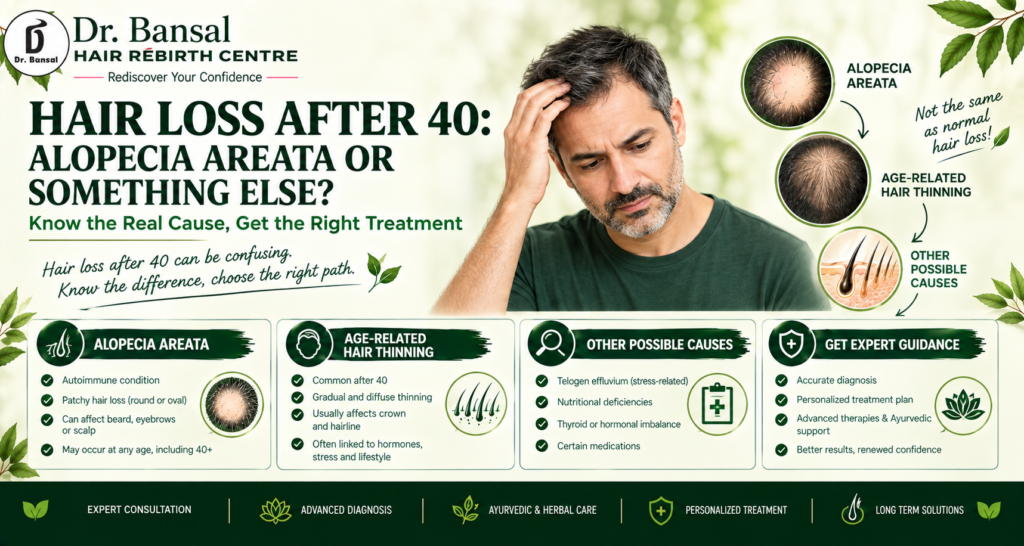
Why Does Hair Loss After 40 Happen?
There is no single explanation for hair loss after 40. Adults may experience gradual thinning because of hereditary pattern hair loss, while others may notice increased shedding after an illness, major physical stress, nutritional deficiency, hormonal changes, or certain medical conditions.
Some types of hair loss develop gradually across the scalp. Alopecia areata can look different. It may begin with one or more clearly defined, smooth patches, and hair loss can sometimes progress quickly.
This difference in pattern is important because treatment depends on the underlying cause.
Could Hair Loss After 40 Be Alopecia Areata?
Yes. Hair loss after 40 can be associated with alopecia areata, even if you have never experienced it before.
Alopecia areata occurs when the immune system attacks hair follicles. It commonly produces smooth patches of hair loss on the scalp, but it can also affect facial hair, eyebrows, eyelashes, beard areas, or other parts of the body. Some people may experience itching, tingling, burning sensations, or nail changes along with hair loss.
Importantly, alopecia areata does not always progress in the same way. Hair may regrow in some areas while new patches appear elsewhere, making the condition difficult to predict.
Alopecia Areata vs. Common Hair Thinning
One of the biggest clues is the pattern of hair loss after 40.
Hereditary pattern hair loss generally develops gradually and may cause widening of the part, a receding hairline, or thinning around the crown. Alopecia areata more commonly produces distinct, smooth patches.
However, adults can have more than one type of hair loss at the same time. For example, someone may have hereditary thinning along with a new alopecia areata patch. That is why simply looking at the amount of hair being shed may not provide the complete answer.
A professional examination can help identify whether the follicles are showing signs of autoimmune hair loss, breakage, inflammation, or another condition.
What About Sudden Hair Shedding?
Not every case of sudden hair loss after 40 is alopecia areata.
Some adults experience excessive shedding after recovering from a significant illness, surgery, major physical stress, or another trigger. This type of shedding can be different from patchy autoimmune hair loss. The timing, pattern, scalp appearance, and medical history all provide useful clues.
The American Academy of Dermatology notes that finding the underlying cause is an important first step because different causes of hair loss require different approaches. Depending on the situation, a healthcare professional may examine the scalp and nails, assess the hair, and sometimes recommend blood tests or a scalp biopsy.
When Should You Get Your Hair Loss Checked?
Consider professional evaluation if your hair loss after 40:
- Appears suddenly or progresses quickly
- Creates smooth, clearly defined bald patches
- Affects eyebrows, eyelashes, beard, or body hair
- Occurs together with noticeable nail changes
- Continues despite changes in your routine
- Is accompanied by scalp symptoms
- Is causing significant concern or affecting your everyday life
Early evaluation does not necessarily mean that aggressive treatment is required. In some cases, monitoring may be appropriate. The important step is understanding what is actually causing the hair loss before choosing a treatment plan.
How Is Alopecia Areata Diagnosed in Adults?
Diagnosis usually begins with a detailed history and examination of the areas affected by hair loss after 40. A dermatologist or qualified hair-loss professional may examine the scalp, nails, eyebrows, beard, and other affected areas.
A dermatoscope can provide a closer look at the scalp and hair follicles. In selected cases, blood tests may be considered to investigate conditions such as thyroid problems, iron deficiency, or vitamin abnormalities. A biopsy may sometimes be required when the diagnosis is uncertain.
Treatment for Hair Loss After 40 Depends on the Cause
There is no single treatment that works for every type of hair loss after 40.
For limited alopecia areata, some people may experience spontaneous regrowth, while others may benefit from medically supervised treatments such as topical corticosteroids or corticosteroid injections. More extensive alopecia areata may require different approaches. Current treatment decisions depend on the extent and duration of hair loss, age, affected areas, previous treatments, and individual health factors.
For adults with severe alopecia areata, treatment recommendations have also evolved in recent years, with newer immune-targeting medicines becoming part of specialist care. Treatment should always be discussed with an appropriately qualified healthcare professional because these medicines have specific indications, precautions, and monitoring requirements.
Why Visit Dr. Bansal Hair Rebirth Centre for Hair Loss?
If you are experiencing unexplained hair loss after 40, getting the pattern assessed can help you understand what may be happening instead of assuming it is simply age-related.
At Dr. Bansal Hair Rebirth Centre, Ghaziabad, the centre states that it provides care for alopecia and hair-loss concerns, including alopecia areata, hair fall, thinning, and balding. Its published approach includes personalized assessment, scalp analysis, Ayurvedic and herbal care, and nutritional and lifestyle guidance.
A consultation can help you discuss when your hair loss started, how quickly it developed, whether it is patchy or diffuse, previous illnesses or treatments, family history, and other factors that may help identify the cause.
Contact us. https://drbansalhairrebirthcenter.in/contact-us/.
Final Thoughts
Hair loss after 40 is not always simply a consequence of age. Gradual hereditary thinning, temporary shedding, nutritional or medical problems, and alopecia areata can present differently and may require different approaches.
If you notice sudden patches, rapid progression, eyebrow or beard involvement, or unusual changes in your scalp or nails, professional evaluation can provide greater clarity. The earlier you understand the pattern and possible cause, the easier it becomes to discuss appropriate management options.
FAQs
Can alopecia areata start after 40?
Yes. Alopecia areata can occur at different ages, including adulthood. A new case after 40 should be evaluated based on its pattern and other symptoms.
Is all hair loss after 40 permanent?
No. Some forms of shedding can improve after the underlying trigger resolves, while other types may require ongoing management.
Can alopecia areata affect eyebrows or beard hair?
Yes. Alopecia areata can affect hair-bearing areas beyond the scalp, including eyebrows, eyelashes, and beard areas.
Should I wait if I suddenly develop a bald patch?
A sudden smooth bald patch is worth getting evaluated because several conditions can cause hair loss, and an accurate diagnosis helps determine whether treatment or monitoring is appropriate.
Contact Details
Dr. Bansal Hair Rebirth Center
MZ-07/08, Sumedha Tower, RDC, Raj Nagar, Ghaziabad
Phone: +91 8595340077
Website: https://drbansalhairrebirthcenter.in/
know more about us – https://vedantamayurveda.in/