
Hair loss around the forehead or temples can be especially noticeable. You may suddenly see more scalp near the front of your head, an uneven hairline, or a small bald area that was not there before. While gradual changes to the hairline can happen for several reasons, hairline hair loss that appears suddenly or in a clearly defined area deserves attention.
Thank you for reading this post, don't forget to subscribe!One possible cause is alopecia areata. However, hairline hair loss does not automatically mean that you have alopecia areata. Understanding the pattern, speed and appearance of the loss can help you know when professional evaluation may be useful.
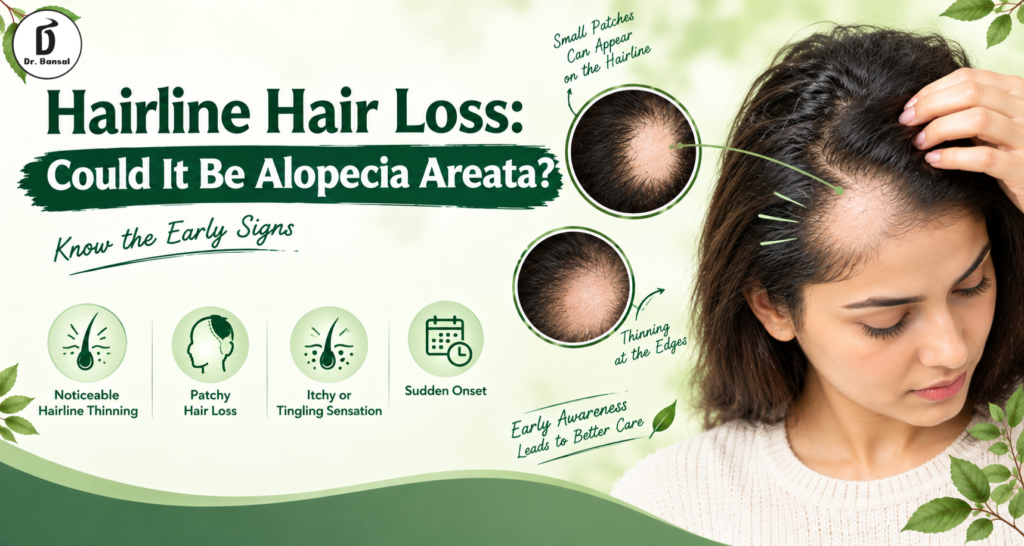
What Is Hairline Hair Loss?
Hairline hair loss refers to reduced hair density or a visible bald area along the front hairline, temples or nearby scalp.
It can develop gradually or appear surprisingly quickly. Some people notice a small area first, while others may see several areas becoming thinner over time.
The important thing is that hairline hair loss can have different causes. Hair follicles can be affected by immune-related conditions, repeated physical tension, hair breakage, scalp conditions and other forms of hair loss.
This is why looking only at the location of the hair loss is not enough to identify the cause.
Can Alopecia Areata Cause Hairline Hair Loss?
Yes. Alopecia areata can cause hairline hair loss, particularly when the condition produces distinct patches around the scalp.
Alopecia areata commonly causes sudden, smooth, round or oval areas of hair loss. Although the scalp is frequently affected, hair loss can occur anywhere that hair grows.
In some cases, hairline hair loss may therefore be the first noticeable change.
The affected skin may look relatively normal, without obvious scaling or significant inflammation. Hair loss can occur in one area while other parts of the scalp continue to look completely normal.
What Does Alopecia-Related Hairline Hair Loss Look Like?
When hairline hair loss is associated with alopecia areata, you may notice:
- A clearly defined bald patch near the forehead
- A smooth area with little or no visible hair
- Sudden thinning in one specific section
- An uneven hairline that was not present previously
- Additional patches appearing later
- Fine new hairs appearing inside an area that previously lost hair
- Hair loss involving eyebrows, eyelashes or other areas
Some people may also experience itching, tingling or a burning sensation around an area affected by alopecia areata. Nail changes can occur in some people as well.
However, these signs do not confirm the diagnosis by themselves.
Is Hairline Hair Loss Always Alopecia Areata?
No. Hairline hair loss can happen for many reasons.
Repeated pulling or tension from certain hairstyles can affect the hairline. Hair breakage can also make the front of the scalp look thinner without causing true loss of the entire follicle.
Some scalp conditions can cause hair loss together with scaling, redness, soreness or irritation. Other forms of hair loss may produce gradual thinning rather than a smooth, clearly defined bald patch.
This difference is important because hairline hair loss that appears suddenly and looks like a smooth patch can require a different evaluation from slow thinning across the entire front of the scalp.
Sudden Hairline Hair Loss vs Gradual Hairline Changes
The speed of hairline hair loss can provide an important clue.
Gradual thinning may become noticeable over months or years. You might slowly see more scalp or notice that your hairline looks different in photographs.
Sudden hairline hair loss, on the other hand, may become noticeable within days or weeks. A small bald patch can appear seemingly without warning.
Alopecia areata is known for sudden hair loss, often beginning with smooth, well-defined patches.
That does not mean every sudden change is alopecia areata. Instead, sudden hairline hair loss is a reason to pay closer attention to the pattern and consider professional assessment.
Can Hairline Hair Loss Grow Back?
Hair regrowth depends on the underlying cause.
When hairline hair loss is associated with alopecia areata, regrowth can occur because the condition generally does not permanently destroy the hair follicles. Some people experience spontaneous regrowth, while others may experience repeated periods of hair loss and regrowth.
New hair may initially appear finer or lighter than the person’s usual hair. It may even appear white or blonde before gradually becoming more similar to the surrounding hair.
Therefore, seeing small new hairs after hairline hair loss can be a sign of regrowth, but it does not guarantee that the condition will not return.
How Is the Cause of Hairline Hair Loss Identified?
A proper evaluation begins with understanding the history of the hairline hair loss.
Important questions may include:
- When did the hair loss begin?
- Did it appear suddenly or gradually?
- Has the affected area become larger?
- Are there other bald patches?
- Has similar hair loss happened before?
- Is there hair loss involving eyebrows or eyelashes?
- Are there scalp changes such as scaling, redness or irritation?
- Have there been noticeable changes to the nails?
- Does anyone in the family have a history of similar hair loss?
A professional may examine the scalp and hair closely and use magnification to look for features that are difficult to see with the naked eye. When the cause is uncertain, additional investigations may sometimes be considered.
When Should You Take Hairline Hair Loss Seriously?
You should consider getting hair loss evaluated when it:
- Appears suddenly
- Creates a smooth bald patch
- Continues expanding
- Appears in multiple areas
- Keeps returning after regrowth
- Occurs with eyebrow or eyelash loss
- Is accompanied by unusual scalp symptoms
- Appears alongside nail changes
- Cannot be explained by normal styling or hair breakage
Early evaluation can help you understand whether the hairline hair loss is associated with alopecia areata or another condition.
Why You Need to Visit Dr. Bansal Hair Rebirth Centre
If you are experiencing hairline hair loss in Ghaziabad or nearby areas, an individual assessment can help you understand the pattern instead of simply assuming that it is ordinary hair fall.
Dr. Bansal Hair Rebirth Centre in Raj Nagar, Ghaziabad, focuses on alopecia and different hair and scalp concerns. The centre describes its approach as personalized, with hair and scalp assessment and individualized care planning.
For people concerned about sudden hair loss, discussing when the loss started, how it has changed and whether similar episodes have occurred before can make the consultation more informative.
The centre is located at MZL 07/08, Sumedha Tower, Ansal Building, Raj Nagar, Ghaziabad, Uttar Pradesh 201002.
Contact us. https://drbansalhairrebirthcenter.in/contact-us/.
Frequently Asked Questions
Can alopecia areata cause hairline hair loss?
Yes. Alopecia areata can produce sudden, smooth patches of hair loss, including areas near the hairline.
Is sudden hairline hair loss always alopecia areata?
No. Hairline hair loss can have several causes, including physical tension, breakage and other scalp or hair conditions.
Can hair grow back after hairline hair loss?
Depending on the cause, hair may regrow. Alopecia areata can involve periods of hair loss followed by regrowth, although its course can be unpredictable.
Can new hair look different after hairline hair loss?
Yes. Regrowing hair can initially be finer or lighter than surrounding hair before becoming more similar over time.
When should I visit Dr. Bansal Hair Rebirth Centre?
Consider an evaluation if hairline hair loss appears suddenly, spreads, returns repeatedly or occurs with other unusual hair, scalp or nail changes.
Final Thoughts
Hairline hair loss can be worrying because even a small change around the forehead or temples can become very noticeable. However, the location alone cannot tell you exactly why the hair is disappearing.
When hair loss appears suddenly, forms a smooth patch or continues to change, alopecia areata is one possibility worth considering. Other causes can produce similar-looking changes, which is why an appropriate evaluation matters.
Rather than assuming that every change in the hairline is normal hair fall, pay attention to the pattern, timing and progression. Understanding the reason behind hairline hair loss is the first step toward making informed decisions about your hair and scalp health.
Contact Details
Dr. Bansal Hair Rebirth Center
MZ-07/08, Sumedha Tower, RDC, Raj Nagar, Ghaziabad
Phone: +91 8595340077
Website: https://drbansalhairrebirthcenter.in/
know more about us – https://vedantamayurveda.in/