
Finding extra hair on a child’s pillow, comb, clothes, or bathroom floor can be worrying for any parent. When the change happens quickly, many parents immediately think about alopecia areata. However, Sudden Hair Loss in Children can have several different causes, and understanding the pattern is important before assuming that alopecia is responsible.
Thank you for reading this post, don't forget to subscribe!Sudden Hair Loss in Children may occur after a fever, infection, significant illness, nutritional problem, scalp condition, tight hairstyle, or other physical changes. Alopecia areata is another possibility, particularly when hair disappears in smooth, clearly defined patches. Knowing the difference can help parents respond calmly and seek appropriate professional advice.
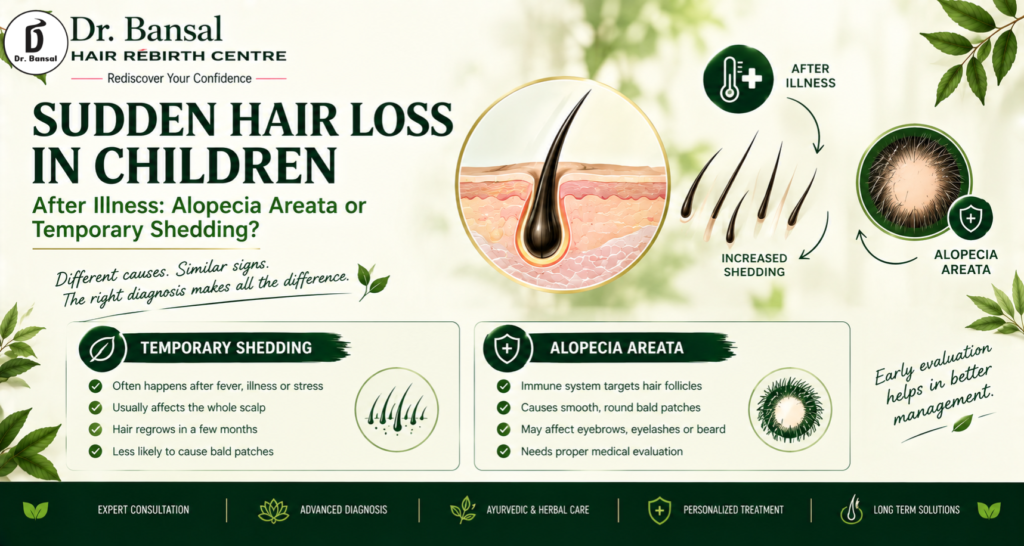
What Does Sudden Hair Loss in Children Look Like?
Sudden Hair Loss in Children does not always appear in the same way. Some children experience increased shedding across the scalp, while others develop one or more clearly visible bald patches.
Parents may notice:
- A smooth round or oval bald patch
- Several bald patches appearing over time
- More hair than usual on the pillow or comb
- General thinning across the scalp
- Eyebrow or eyelash hair loss
- Broken hairs
- Scalp scaling or irritation
- Hair loss appearing after a fever or illness
The pattern can provide useful clues. Alopecia areata is an immune-mediated condition in which the immune system mistakenly targets hair follicles. It commonly causes smooth patches and can begin during childhood. It is also not contagious.
Can Fever or Illness Cause Hair Shedding?
Yes. A significant illness or fever can sometimes be followed by temporary excessive hair shedding. This is different from alopecia areata.
After physical stress such as a major illness, fever, surgery, or another health event, some hair follicles can enter a resting phase. Increased shedding may become noticeable later rather than immediately. This type of shedding is commonly known as telogen effluvium.
Therefore, Sudden Hair Loss in Children after an illness does not automatically mean that the child has an autoimmune hair-loss condition. Temporary shedding can occur while the normal hair-growth cycle readjusts.
However, timing alone cannot establish the cause. If Sudden Hair Loss in Children is severe, persistent, patchy, spreading, or accompanied by other symptoms, professional evaluation is important.
How Is Alopecia Areata Different?
Alopecia areata often has a recognizable pattern. A child may suddenly develop a smooth, round or oval area where hair has disappeared. The affected skin may look relatively normal rather than heavily inflamed or scaly.
Alopecia areata can affect more than the scalp. Some children may experience loss of:
- Eyebrows
- Eyelashes
- Facial hair
- Hair on other parts of the body
Nail changes can also occur in some people.
Sudden Hair Loss in Children is more suggestive of alopecia areata when clearly defined bald patches appear suddenly, several patches develop, hair loss repeatedly returns, or hair outside the scalp is affected.
Still, Sudden Hair Loss in Children should never be diagnosed from appearance alone. Fungal scalp infections, hair-pulling, traction from tight hairstyles, nutritional deficiencies, and other scalp or hair conditions can produce similar-looking changes. A proper diagnosis should come before treatment.
Why Proper Diagnosis Matters
When Sudden Hair Loss in Children appears, parents may be tempted to immediately change shampoos, start supplements, or try online hair-growth remedies. Unfortunately, this can delay identification of the actual cause.
During an evaluation, a healthcare professional may ask:
- When did the hair loss begin?
- Did the child recently have a fever or illness?
- Is the hair falling out or breaking?
- Has the child experienced itching or scalp scaling?
- Is there a family history of alopecia or autoimmune conditions?
- Are the eyebrows or eyelashes affected?
- Has the child experienced previous episodes?
The scalp and nails may also be examined closely. A dermatoscope can provide additional information, while blood tests or other investigations may sometimes be considered depending on the findings.
Can Hair Grow Back?
The possibility of regrowth depends on the underlying cause.
Some children with limited alopecia areata experience spontaneous hair regrowth. The American Academy of Dermatology notes that many children with one or two small patches may regrow hair without treatment. However, alopecia areata can also return or become more extensive, so appropriate monitoring may be recommended.
Temporary shedding after illness may also improve as the normal hair-growth cycle returns to its usual pattern.
For this reason, Sudden Hair Loss in Children should not automatically be considered permanent hair loss. At the same time, rapidly progressing or unexplained hair loss should not simply be ignored.
What Can Parents Do at Home?
While arranging appropriate professional advice, parents can keep hair and scalp care gentle.
If you notice Sudden Hair Loss in Children:
- Avoid tight braids, ponytails, or hairstyles that pull on the scalp.
- Avoid unnecessary heat and harsh chemical treatments.
- Use gentle hair-care products.
- Provide a balanced, varied diet rather than starting supplements without professional advice.
- Protect areas with reduced hair from excessive sun exposure.
- Keep a simple record of when the hair loss started and whether it is spreading.
- Avoid blaming the child or assuming that stress caused the problem.
Emotional support is important too. Children may become worried when they notice changes in their hair. Listen to their concerns without repeatedly focusing on their appearance.
When Should You Seek Professional Help?
Professional evaluation is especially useful when Sudden Hair Loss in Children involves:
- A bald patch appearing suddenly
- Multiple patches developing or spreading
- Eyebrow or eyelash loss
- Repeated episodes of hair loss
- Significant scalp itching, scaling, redness, or crusting
- Hair loss that continues after an illness
- Rapidly increasing hair loss
- Unexplained thinning or shedding
- Emotional distress related to the hair loss
Early assessment can help distinguish alopecia areata from other causes and reduce the risk of inappropriate self-treatment.
Why You Need to Visit Dr. Bansal Hair Rebirth Centre
If your child is experiencing Sudden Hair Loss in Children and you are looking for professional guidance in Ghaziabad or nearby Delhi-NCR areas, Dr. Bansal Hair Rebirth Centre can be considered for an individual hair and scalp assessment.
The centre focuses on alopecia and hair-loss concerns, including alopecia areata, alopecia totalis, alopecia universalis, hair thinning, and hair fall. Its official website describes a personalized approach involving hair and scalp assessment, Ayurvedic and herbal care, nutritional and lifestyle guidance, and technology-assisted scalp assessment.
For children, the priority should be understanding why the hair loss is occurring rather than simply promising faster regrowth. Age, health history, extent of hair loss, and the child’s individual situation all matter when considering care. The AAD specifically notes that children can require different treatment approaches depending on their age and the extent of hair loss.
Dr. Bansal Hair Rebirth Centre is located at MZL 07/08, Sumedha Tower, Ansal Building, Raj Nagar, Ghaziabad, Uttar Pradesh 201002. The centre’s official website lists +91-9953250910 for appointments and enquiries.
Contact us. https://drbansalhairrebirthcenter.in/contact-us/.
Final Thoughts
Sudden Hair Loss in Children can be alarming, but it does not always mean alopecia areata or permanent baldness. Hair shedding after illness, alopecia areata, scalp infections, traction, nutritional problems, and other conditions can look different and require different approaches.
The best first step is to observe the pattern rather than immediately guessing the cause. When Sudden Hair Loss in Children is sudden, patchy, persistent, recurring, or progressing, professional assessment can provide clarity.
With accurate information, appropriate evaluation, and supportive care, parents can help children navigate hair loss without unnecessary fear or confusion.
Frequently Asked Questions
Can fever cause Sudden Hair Loss in Children?
Yes. A significant illness or fever can sometimes be followed by temporary increased hair shedding. This is different from alopecia areata.
How can I tell if my child has alopecia areata?
Smooth, clearly defined round or oval bald patches can be a sign of alopecia areata, but other conditions can look similar. A professional examination is the safest way to determine the cause.
Is alopecia areata contagious?
No. Alopecia areata is an immune-mediated condition and cannot be passed from one child to another through normal contact.
Can children with alopecia areata regrow their hair?
Yes. Some children with limited alopecia areata experience spontaneous regrowth, although recurrence or progression can occur.
Should I give my child hair-growth supplements?
Do not start supplements simply because hair loss has appeared. If a nutritional deficiency is suspected, a healthcare professional can determine whether testing or supplementation is appropriate.
Contact Details
Dr. Bansal Hair Rebirth Center
MZ-07/08, Sumedha Tower, RDC, Raj Nagar, Ghaziabad
Phone: +91 8595340077
Website: https://drbansalhairrebirthcenter.in/
know more about us – https://vedantamayurveda.in/