
Seeing a bald patch appear suddenly on a young child’s scalp can be frightening for any parent. You may wonder whether it is caused by poor nutrition, stress, an infection, hair products, or something more serious. Alopecia Areata in Young Children is one possible explanation for sudden or patchy hair loss, and understanding its early signs can help parents know when professional evaluation is appropriate.
Thank you for reading this post, don't forget to subscribe!Alopecia Areata in Young Children can appear unexpectedly, sometimes when a child previously had completely normal hair growth. The condition is an autoimmune form of hair loss in which the immune system mistakenly targets hair follicles. It can affect children of different ages and may cause anything from a small bald patch to more extensive hair loss.
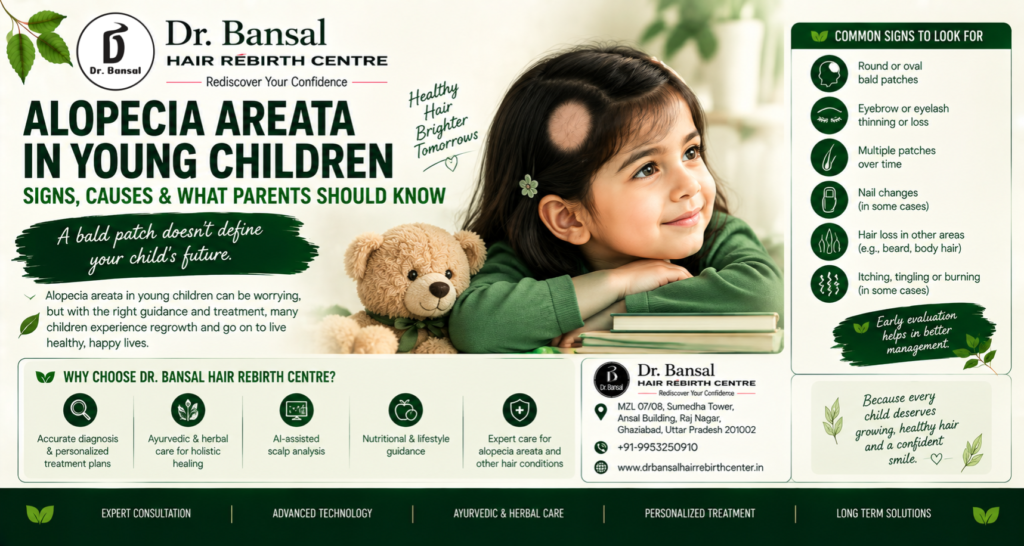
What Is Alopecia Areata in Young Children?
Alopecia Areata in Young Children generally appears as sudden, smooth and clearly defined areas where hair has disappeared. The affected skin may look relatively normal, without obvious scaling or severe inflammation.
Unlike ordinary daily shedding, Alopecia Areata in Young Children may make it look as though hair has vanished from one specific area. Some children develop only one patch, while others may develop additional patches over time.
It is important to remember that not every bald patch is alopecia areata. Fungal scalp infections, hair-pulling, traction from tight hairstyles and other scalp or hair conditions can produce similar-looking changes. This is why parents should avoid trying to diagnose the condition based only on appearance.
What Are the First Signs Parents May Notice?
The first signs of Alopecia Areata in Young Children can be easy to miss, particularly when the affected area is small.
Parents may notice:
- A round or oval smooth bald patch
- A small area becoming noticeably thinner
- Several bald patches appearing over time
- Sudden eyebrow thinning
- Loss of eyelashes
- Hair loss in other body areas
- Nail changes in some cases
- Occasional itching, tingling or burning around an affected area
The American Academy of Dermatology notes that alopecia areata commonly begins with a smooth round or oval patch but can also affect eyebrows, eyelashes and other body hair. Nail changes may occur in some people as well.
With Alopecia Areata in Young Children, parents should pay attention to changes rather than waiting for hair loss to become extensive.
Is Sudden Hair Loss Always Alopecia Areata?
No. This is one of the most important things parents should understand.
Alopecia Areata in Young Children is only one possible cause of sudden hair loss. Children can also experience hair shedding after significant illness or fever, nutritional problems, scalp infections, physical stress, tight hairstyles, hair-pulling and other conditions.
For example, hair shedding after an illness may appear more diffusely across the scalp rather than as one clearly defined bald patch. A smooth, sharply defined bald patch can raise suspicion of alopecia areata, but examination is still needed for an accurate diagnosis.
This is why parents should not immediately blame themselves, the child’s diet, school stress or a particular shampoo.
Why Can Alopecia Areata Happen in Children?
The exact cause of Alopecia Areata in Young Children is not completely understood.
The condition is considered autoimmune, meaning the immune system mistakenly attacks hair follicles and interferes with normal hair growth. Genetic susceptibility and other factors may contribute to a child’s risk, but having a family history does not mean a child will definitely develop alopecia areata.
Stress is also commonly blamed for hair loss. However, parents should avoid assuming that stress alone caused Alopecia Areata in Young Children. The condition involves immune-system activity and is more complicated than simply being caused by emotional stress.
Can Hair Grow Back?
Yes, hair regrowth is possible.
Some children with limited Alopecia Areata in Young Children experience spontaneous hair regrowth without treatment. However, the course is unpredictable. Some children may have one episode and then remain stable, while others may experience recurring patches or more extensive hair loss.
The American Academy of Dermatology explains that treatment decisions depend on factors such as the child’s age, amount and location of hair loss, and how long the condition has been present. Children may require different treatment approaches from adults.
Therefore, parents should not start medicines or hair-growth products on their own. A qualified healthcare professional should decide whether treatment is appropriate and what type of care is suitable for the child.
How Is Alopecia Areata in Young Children Evaluated?
During an evaluation for Alopecia Areata in Young Children, a specialist may examine the scalp, hair pattern and nails while asking about the child’s medical and family history.
Depending on the presentation, additional examination or testing may sometimes be considered. The AAD notes that diagnosis can involve scalp examination and, when necessary, tools such as dermoscopy, blood tests or other investigations to rule out possible underlying conditions.
The goal is not simply to identify hair loss but to understand why it is happening.
When Should Parents Seek Professional Help?
Parents should consider an evaluation for Alopecia Areata in Young Children if they notice:
- A sudden smooth bald patch
- Multiple patches appearing
- Rapidly increasing hair loss
- Eyebrow or eyelash loss
- Hair loss on other parts of the body
- Repeated episodes of unexplained hair loss
- Nail changes alongside hair loss
- Persistent shedding without an obvious explanation
Early evaluation does not necessarily mean the condition is severe. It simply gives the family a better understanding of what may be happening.
Why You Need to Visit Dr. Bansal Hair Rebirth Centre
If your child develops sudden or unexplained hair loss, professional assessment can help distinguish Alopecia Areata in Young Children from other causes of hair loss.
Dr. Bansal Hair Rebirth Centre in Ghaziabad focuses on alopecia and hair-loss concerns, including alopecia areata, alopecia totalis, alopecia universalis, hair fall, hair thinning and scalp concerns. The centre describes an individualized approach involving hair and scalp assessment, personalized care planning, nutritional and lifestyle guidance, Ayurvedic and herbal approaches, and follow-up monitoring.
For Alopecia Areata in Young Children, involving a parent or guardian in the consultation is especially important. The priority should be understanding the diagnosis and selecting age-appropriate care rather than immediately trying multiple products.
Dr. Bansal Hair Rebirth Centre is located at MZL 07/08, Sumedha Tower, Ansal Building, Raj Nagar, Ghaziabad, Uttar Pradesh 201002. The centre’s official website publishes +91-9953250910 as a contact number.
Contact us. https://drbansalhairrebirthcenter.in/contact-us/.
Final Thoughts
Alopecia Areata in Young Children can be unexpected, but a bald patch does not automatically mean permanent hair loss. Some children experience regrowth, while others may need ongoing monitoring or treatment.
The most useful first step is to identify the actual cause instead of guessing. If you notice sudden, patchy or unexplained hair loss in your child, seek professional guidance and avoid experimenting with random hair-growth products.
With proper evaluation, supportive care and age-appropriate management, families can better understand Alopecia Areata in Young Children and make informed decisions about their child’s hair and scalp health.
Frequently Asked Questions
Can young children develop alopecia areata?
Yes. Alopecia areata can develop at any age and often first appears during childhood.
Is alopecia areata contagious?
No. Alopecia areata is an autoimmune condition and is not spread through normal contact.
Can alopecia areata affect a child’s eyebrows or eyelashes?
Yes. Alopecia Areata in Young Children can involve scalp hair as well as eyebrows, eyelashes and other body hair.
Can a child’s hair grow back naturally?
Yes. Some children experience spontaneous regrowth, particularly when hair loss is limited. However, the course varies from child to child.
Should parents use hair oils or supplements immediately?
Parents should first determine the cause of the hair loss. Random products or supplements may not address the underlying condition. Any treatment for a child should be discussed with an appropriate healthcare professional.
When should I take my child to Dr. Bansal Hair Rebirth Centre?
Consider professional evaluation when your child develops sudden bald patches, rapidly progressing hair loss, recurring patches, eyebrow or eyelash loss, or unexplained changes in hair density.
Contact Details
Dr. Bansal Hair Rebirth Center
MZ-07/08, Sumedha Tower, RDC, Raj Nagar, Ghaziabad
Phone: +91 8595340077
Website: https://drbansalhairrebirthcenter.in/
know more about us – https://vedantamayurveda.in/