Children today are growing up in a highly connected world where school, friendships, photographs, social media and online communication can all influence how they feel about themselves. When sudden hair loss appears, it can therefore be confusing for both the child and the family. Alopecia Areata in Gen Alpha is an important topic for parents because alopecia areata can begin during childhood and may appear suddenly without an obvious warning.
Thank you for reading this post, don't forget to subscribe!Alopecia Areata in Gen Alpha does not mean that every child with hair loss has an autoimmune condition. Hair loss in children can have several possible causes, so identifying the reason before starting treatment is important.
What Is Alopecia Areata?
Alopecia areata is an immune-mediated condition that causes hair loss. The immune system mistakenly targets hair follicles, which can result in smooth, round or oval patches of missing hair. It can affect the scalp as well as eyebrows, eyelashes, beard areas and other body hair.
Alopecia Areata in Gen Alpha can look different from one child to another. One child may develop a single small bald patch, while another may develop several patches or more extensive hair loss. In some cases, hair may regrow and later fall out again.
Why Can Alopecia Areata Appear in Gen Alpha?
There is no single reason why a particular child develops alopecia areata. Research suggests that genetic and environmental factors can contribute to the condition.
It is also important for parents to understand that Alopecia Areata in Gen Alpha is not caused simply by poor hair care. It is also not contagious, meaning children cannot catch it from classmates, friends or siblings through normal contact.
Parents should therefore avoid blaming themselves or the child when sudden hair loss appears.
What Does Alopecia Areata in Gen Alpha Look Like?
Recognising the pattern of hair loss can help parents know when professional evaluation may be useful.
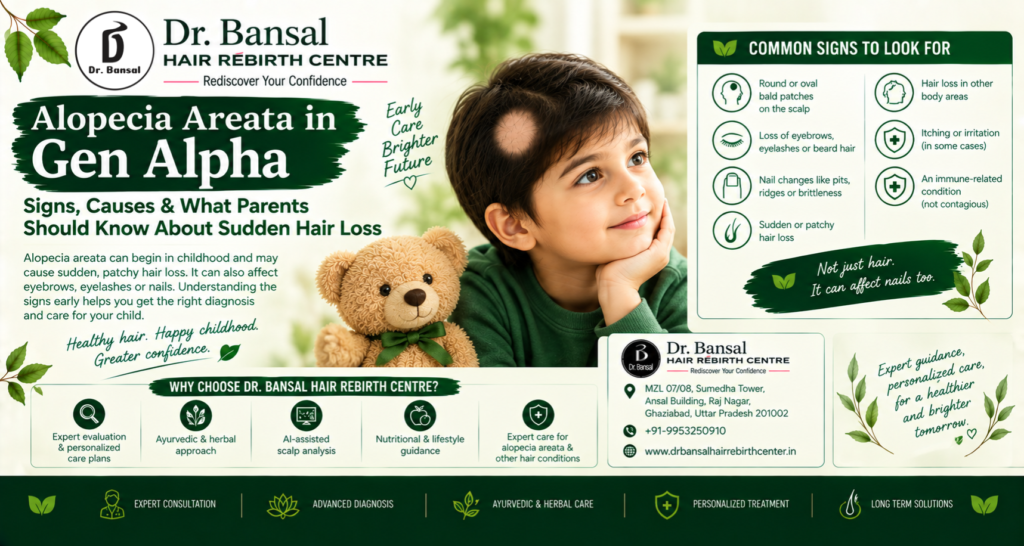
Possible signs of Alopecia Areata in Gen Alpha include:
- A sudden smooth bald patch on the scalp
- Multiple round or oval patches
- Hair loss appearing over a short period
- Eyebrow or eyelash thinning
- Hair loss affecting other body areas
- Hair growing back in some places while falling out elsewhere
- Occasionally, changes involving the nails
However, not every bald patch is alopecia areata. Other conditions can cause hair loss in children, which is why a proper assessment is more useful than trying to diagnose the condition at home.
How Can Alopecia Areata Affect a Child’s Daily Life?
Alopecia Areata in Gen Alpha is not only a hair-related issue. A child may have questions about why their hair looks different, especially when classmates notice a bald patch.
Some children may become uncomfortable discussing their hair loss, while others may have questions about whether they can continue normal activities. Older children and adolescents may also be more concerned about social interactions and how other people respond to visible hair loss. NAAF specifically notes that alopecia areata can be emotionally challenging for children and adolescents.
Parents can help by listening without making the child feel that their appearance is the most important thing about them. School staff can also be informed when appropriate so the child has supportive adults around them.
How Is Alopecia Areata Diagnosed in Children?
Diagnosing Alopecia Areata in Gen Alpha usually starts with a detailed history and examination.
A healthcare professional may ask when the hair loss started, whether it developed quickly, whether similar episodes have happened before, and whether there is a family history of alopecia areata.
The scalp and nails may be examined, and a dermatoscope can provide a closer look at the affected area. Depending on the situation, additional investigations such as blood tests or a biopsy may sometimes be considered.
The important point is that parents should not assume that sudden hair loss is automatically caused by stress, nutrition or a particular shampoo.
Is Treatment the Same for Every Child?
No. Treatment for Alopecia Areata in Gen Alpha depends on factors such as the child’s age, amount of hair loss, location of the hair loss, duration and individual circumstances.
The AAD notes that some children with limited hair loss may regrow their hair without treatment. When treatment is appropriate, the options can differ according to age and severity. Children should not be given prescription medicines or strong hair-growth products without appropriate professional guidance.
NAAF also explains that treatment decisions can depend on the type and severity of alopecia, the child’s age and previous treatment history.
For example, in the United States, ritlecitinib is approved for severe alopecia areata in adolescents aged 12 and older. This does not mean it is appropriate for every child, and treatment decisions should always be made with a qualified healthcare professional.
What Should Parents Do When Sudden Hair Loss Appears?
When parents notice Alopecia Areata in Gen Alpha, the first step should be staying calm and observing the pattern.
Take note of when the hair loss started, whether new patches are appearing, and whether eyebrows or eyelashes are affected. Avoid repeatedly changing shampoos, applying multiple hair oils or starting supplements without knowing the cause.
A professional evaluation can help distinguish alopecia areata from other causes of childhood hair loss and determine whether monitoring, testing or treatment is appropriate.
Why You Need to Visit Dr. Bansal Hair Rebirth Centre
If your child develops sudden, patchy or unexplained hair loss, professional assessment can help the family understand what may be happening.
Dr. Bansal Hair Rebirth Centre in Ghaziabad focuses on alopecia and hair-loss concerns, including alopecia areata, alopecia totalis, alopecia universalis, hair fall, hair thinning and scalp concerns. The centre describes an individualized approach involving hair and scalp assessment, personalized care planning, Ayurvedic and herbal approaches, nutritional and lifestyle guidance, and technology-assisted scalp assessment.
For Alopecia Areata in Gen Alpha, involving a parent or guardian in the consultation is especially important. The priority should be understanding the diagnosis and selecting age-appropriate care rather than simply trying to make hair grow faster.
Dr. Bansal Hair Rebirth Centre is located at MZL 07/08, Sumedha Tower, Ansal Building, Raj Nagar, Ghaziabad, Uttar Pradesh 201002. The centre’s published contact number is +91-9953250910.
Contact us. https://drbansalhairrebirthcenter.in/contact-us/.
Frequently Asked Questions
Can children develop alopecia areata?
Yes. Alopecia areata can begin at any age and commonly begins during childhood or early life.
Is Alopecia Areata in Gen Alpha contagious?
No. Alopecia areata is an immune-mediated condition and cannot be passed from one child to another through ordinary contact.
Can hair grow back after alopecia areata?
Yes. Some children experience spontaneous hair regrowth, particularly when hair loss is limited. However, the course varies and recurrence can occur.
Should parents give children hair-growth supplements?
Parents should first identify the possible cause of the hair loss. Supplements should not be started routinely without appropriate professional advice.
When should a child be evaluated?
Consider an evaluation when hair loss is sudden, patchy, rapidly progressing, recurring, or accompanied by eyebrow, eyelash or other body-hair loss.
Final Thoughts
Alopecia Areata in Gen Alpha can be unexpected, but sudden hair loss does not automatically mean permanent hair loss. The condition can vary considerably between children, and some children may experience natural regrowth.
The most useful first step is to understand what is actually causing the hair loss rather than immediately experimenting with products or assuming that stress is responsible.
With appropriate evaluation, supportive family involvement and age-appropriate care, Alopecia Areata in Gen Alpha can be approached with greater understanding and less fear. If your child develops sudden or unexplained hair loss, speaking with a qualified healthcare professional can help you understand the next appropriate step.
Contact Details
Dr. Bansal Hair Rebirth Center
MZ-07/08, Sumedha Tower, RDC, Raj Nagar, Ghaziabad
Phone: +91 8595340077
Website: https://drbansalhairrebirthcenter.in/
know more about us – https://vedantamayurveda.in/