
When you notice a bald patch appearing suddenly, it is natural to wonder what is happening beneath your scalp. Why does hair stop growing in one area? Can the follicles recover? And why does hair sometimes return while new patches develop elsewhere?
Thank you for reading this post, don't forget to subscribe!Understanding Alopecia Areata Hair Growth begins with understanding hair follicles, the tiny structures in your skin responsible for producing hair. Alopecia areata is an immune-related condition that affects these follicles and can cause sudden hair loss. Although the condition can look alarming, hair loss does not automatically mean that the follicles have been permanently destroyed.
This guide explains how Alopecia Areata Hair Growth works, what may interrupt the normal growth cycle, what regrowth can look like, and when professional assessment is important.
What Are Hair Follicles and How Do They Work?
Hair follicles are small structures within the skin that produce individual hairs. Each follicle follows a natural cycle involving three main stages.
- Growth phase: The follicle actively produces a hair strand.
- Transition phase: Active growth slows and the follicle begins changing.
- Resting and shedding phase: The hair eventually sheds before another growth cycle may begin.
Healthy hair does not grow continuously at the same rate. Different follicles move through their cycles at different times, which is why some daily shedding is normal.
In Alopecia Areata Hair Growth, this normal process is disrupted by an immune response directed at hair follicles. The affected areas may suddenly lose hair, often forming smooth, round or oval patches. The follicles can remain capable of producing hair, which helps explain why regrowth is possible in many cases.
How Does Alopecia Areata Affect Hair Growth?
Alopecia areata occurs when the immune system mistakenly targets structures associated with hair growth. This can interrupt normal follicle activity and cause hair to fall out earlier than expected.
The effects on Alopecia Areata Hair Growth vary from person to person. Some people develop one small patch, while others experience several patches or more extensive hair loss. The scalp is commonly affected, but the eyebrows, eyelashes, beard and other hair-bearing areas can also be involved.
Importantly, the visible amount of hair loss does not tell the entire story about what is happening inside every follicle. The pattern may change over time, and it is not possible to predict an individual’s recovery accurately from appearance alone.
Can Hair Follicles Recover After Alopecia Areata?
In many cases, hair can regrow after an episode of alopecia areata. Because the condition typically does not cause scarring in affected areas, follicles may remain capable of producing new hair.
However, Alopecia Areata Hair Growth is unpredictable. Some people experience regrowth within a few months, while others may have prolonged hair loss or repeated episodes.
Regrowth in one patch also does not guarantee that no new patches will appear. Hair may return in an earlier area while another area begins losing hair.
This is why monitoring changes and understanding the individual pattern are more useful than assuming that every case will follow the same timeline.
What Does New Hair Growth Look Like?
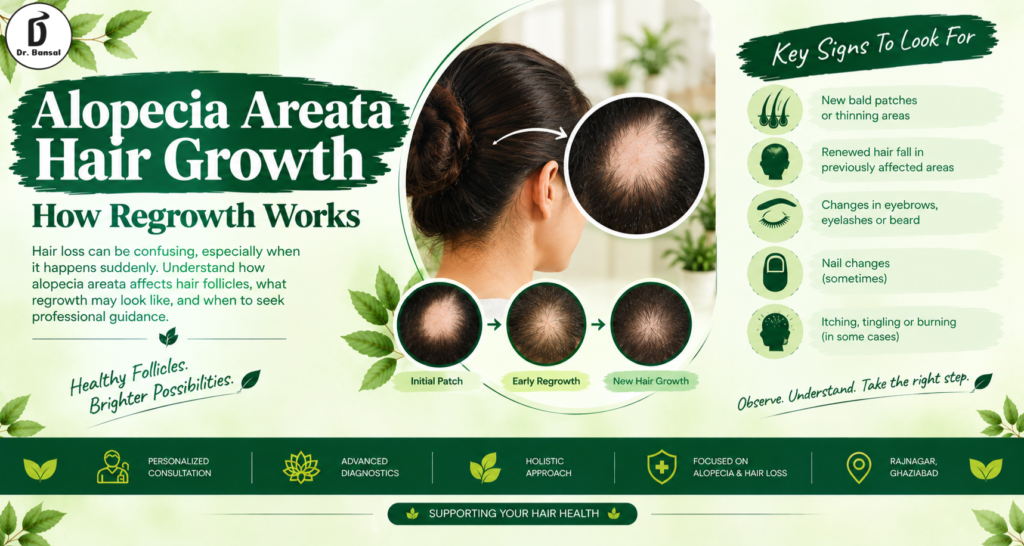
When Alopecia Areata Hair Growth begins again, the first signs may be subtle. You might notice fine, soft hairs appearing within a previously bald patch.
New hair can initially look lighter, white, grey or finer than the surrounding hair. Its texture and colour may gradually change as growth continues, although this does not happen in exactly the same way for everyone.
You may also notice uneven regrowth, with some parts of a patch filling in faster than others. These differences do not necessarily mean that recovery has stopped.
Avoid judging progress from a single photograph. Consistent photographs taken occasionally under similar lighting can provide a more useful picture of visible changes over time.
Signs That Your Hair Growth Pattern Needs Attention
Changes in Alopecia Areata Hair Growth may deserve assessment when you notice:
- New, smooth bald patches appearing on the scalp.
- Hair loss returning in an area where regrowth had started.
- Increasing numbers of patches or patches becoming larger.
- Hair loss involving the eyebrows, eyelashes or beard.
- Small dents or unusual surface changes in the nails.
- Sudden or widespread shedding without an obvious explanation.
These signs can be associated with alopecia areata, but they do not confirm the condition by themselves. Other causes of hair loss can produce similar symptoms, so a proper assessment is important.
Can Everyday Habits Improve Hair Health?
Healthy routines can support general wellbeing and normal hair function, but they cannot guarantee Alopecia Areata Hair Growth or prevent every relapse.
Consider these practical habits:
Eat balanced meals. Include varied sources of protein, fruits, vegetables and other nutritious foods. If a deficiency is suspected, seek appropriate guidance rather than taking supplements without a clear reason.
Handle your hair gently. Avoid excessive pulling, rough brushing and hairstyles that place repeated tension on the scalp.
Maintain regular sleep. A consistent sleep routine supports overall health and can help you manage everyday stress.
Avoid blaming yourself. Alopecia areata is not simply the result of poor hair care or a personal failure. Stress may be relevant in some cases, but it is not the sole explanation for the condition.
These steps support general health, while the underlying cause of hair loss may require separate evaluation.
How Is Alopecia Areata Hair Growth Assessed?
An assessment generally begins with a discussion of when the hair loss started, how it has changed, and whether other areas are affected. A professional may examine the scalp, hair pattern and nails.
Depending on the findings, magnified scalp examination or selected tests may help distinguish alopecia areata from other causes of thinning. The appropriate approach depends on each person’s history and examination.
Seeking guidance is especially important when hair loss is sudden, spreading, persistent or accompanied by scalp discomfort. Do not assume that every bald patch has the same cause.
Why You Need to Visit Dr. Bansal Hair Rebirth Centre
Understanding Alopecia Areata Hair Growth requires looking beyond the visible bald patch and considering the individual’s hair-loss pattern, history and scalp condition.
At Dr. Bansal Hair Rebirth Centre, the focus is on personalised hair and scalp assessment for people experiencing alopecia and other hair-loss concerns. A consultation provides an opportunity to discuss changes in hair density, new patches, regrowth and concerns about recurring shedding.
The appropriate next steps depend on individual findings. Although no provider can guarantee that hair will regrow or that future episodes will never occur, a careful assessment can help you make more informed decisions about your hair health.
Contact Dr. Bansal Hair Rebirth Centre
- Address: MZL 07/08, Sumedha Tower, Ansal Building, Raj Nagar, Ghaziabad, Uttar Pradesh 201002
- Phone: +91-9953250910
- Website: https://drbansalhairrebirthcenter.in/
- Contact us. https://drbansalhairrebirthcenter.in/contact-us/.
Frequently Asked Questions
1. Does alopecia areata permanently destroy hair follicles?
Alopecia areata generally does not cause scarring, so follicles may remain capable of producing hair. However, regrowth varies between individuals.
2. How long does hair regrowth take?
There is no single timeline. Some people notice regrowth within months, while others experience longer-lasting or recurring hair loss.
3. Can hair grow back with a different colour?
Yes. Newly growing hair may initially appear lighter or white before its usual colour returns, although changes vary.
4. Does regrowth mean alopecia areata has ended?
Not necessarily. Hair can regrow in one area while new patches appear elsewhere, so continued observation may be useful.
5. When should I seek an assessment?
Seek professional guidance if you notice sudden bald patches, spreading hair loss, repeated shedding or changes involving other hair-bearing areas.
Conclusion
Understanding Alopecia Areata Hair Growth can make sudden hair loss less confusing. The condition affects normal follicle activity, but it does not automatically mean that hair can never return. Regrowth, recurrence and recovery timelines vary considerably.
Pay attention to changes, handle your hair gently, and seek professional guidance when needed. Learning what may be happening beneath the scalp is a useful first step towards making informed decisions about your hair health.
Contact Details
Dr. Bansal Hair Rebirth Center
MZ-07/08, Sumedha Tower, RDC, Raj Nagar, Ghaziabad
Phone: +91 8595340077
Website: https://drbansalhairrebirthcenter.in/
know more about us – https://vedantamayurveda.in/