
Noticing a bald patch, sudden hair shedding or unexpected changes in hair growth can leave you with many questions. You may wonder what caused the hair loss, whether it will spread and what information a specialist needs to understand your situation.
Thank you for reading this post, don't forget to subscribe!Preparing for an Alopecia Areata Appointment can help you explain your concerns clearly and make better use of your consultation time. Instead of trying to remember every detail during the visit, you can organise your observations, questions and relevant history beforehand.
This guide explains what to record, which changes to mention and how to prepare for an Alopecia Areata Appointment without unnecessary stress.
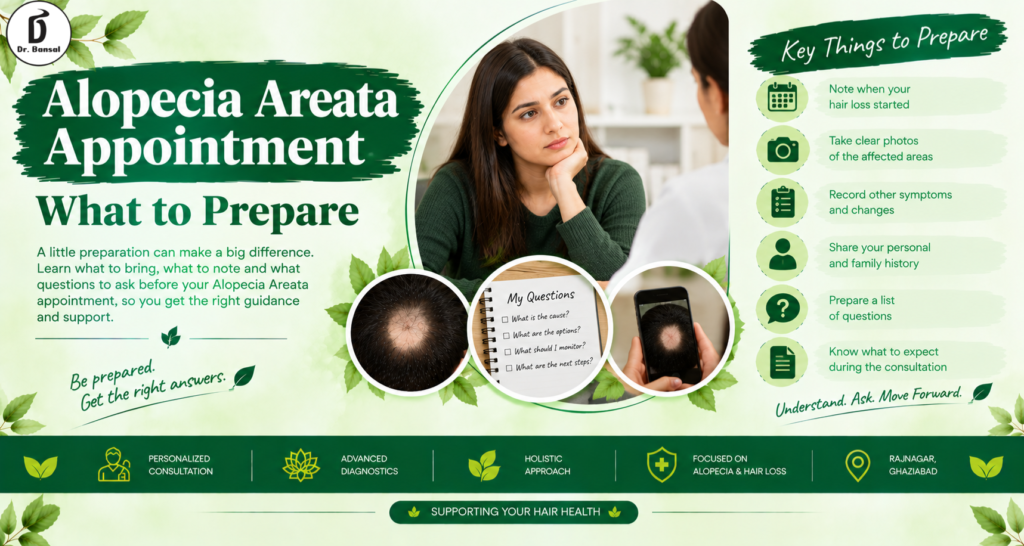
Why Is Preparing for an Alopecia Areata Appointment Important?
Hair loss can develop in different patterns, and several conditions may produce similar-looking symptoms. Alopecia areata is an immune-related condition that can cause smooth, round or oval patches of hair loss. However, not every bald patch or episode of sudden shedding is caused by this condition.
Preparing for an Alopecia Areata Appointment gives you an opportunity to describe when the changes began, where they appeared and how they have progressed.
Useful information may help a professional distinguish between possible causes and decide whether further assessment is needed. Preparation does not guarantee a diagnosis, but it can make the discussion more focused and informative.
1. Record When Your Hair Loss Started
One of the most useful things to bring to an Alopecia Areata Appointment is a simple timeline of your hair loss.
Try to remember:
- When you first noticed a bald patch or increased shedding.
- Whether the change appeared suddenly or developed gradually.
- Whether new patches appeared later.
- Whether the affected areas became larger or smaller.
- Whether you noticed hair regrowth in any area.
You do not need exact dates if you cannot remember them. An approximate timeline is still useful.
If your hair loss began after an illness, major life change or another significant event, mention it without assuming that it was necessarily the cause.
2. Take Clear Photographs of the Affected Areas
Photographs can help you document changes that may be difficult to remember accurately. Before your Alopecia Areata Appointment, consider taking pictures of the affected areas under consistent lighting.
Useful photographs may show:
- The overall appearance of your scalp.
- The location and approximate size of bald patches.
- Any changes along the hairline or crown.
- Areas where hair appears to be growing back.
- Changes in eyebrows, eyelashes or beard hair, if relevant.
Avoid taking photographs every few hours or repeatedly checking your scalp. Occasional, consistent pictures are generally more useful than constant monitoring.
Bring the images on your phone so you can show how the pattern has changed over time.
3. Make a Note of Other Symptoms
Hair loss is not always the only change worth mentioning. Before your Alopecia Areata Appointment, note whether you have experienced itching, tingling, tenderness or burning sensations on your scalp.
Also mention any visible scaling, redness, irritation or discomfort. These symptoms do not automatically indicate alopecia areata, and some may suggest a different scalp condition.
If you have noticed changes in your nails, eyebrows or eyelashes, include those details as well.
The purpose of recording symptoms is not to diagnose yourself. It is to provide a clearer picture of what you have experienced so that the professional can decide which findings matter.
4. Prepare Your Personal and Family History
Your health history can provide useful context during an Alopecia Areata Appointment.
Consider noting:
- Previous episodes of hair loss.
- Whether hair returned after earlier episodes.
- Any relevant family history of alopecia areata or other immune-related conditions.
- Recent illnesses or major physical changes.
- Significant changes in diet, weight or daily routine.
- Previous scalp assessments and any relevant reports.
Only share information that applies to you. A family history does not mean you will necessarily develop the same condition, and an absence of family history does not rule it out.
If you have previous consultation notes or photographs, keep them organised so they are easy to access.
5. Write Down Your Questions Before the Visit
It is easy to forget important questions during a consultation, particularly when you are worried about sudden hair loss. Preparing a short list before your Alopecia Areata Appointment can help you feel more confident.
Consider asking:
- What are the possible explanations for my hair-loss pattern?
- Does the appearance suggest alopecia areata or another condition?
- Is further examination needed?
- What changes should I monitor over time?
- How often should my progress be reviewed?
- What should I do if new bald patches appear?
- Which expectations about regrowth are realistic?
Write down the answers in simple language. If something is unclear, ask for an explanation rather than leaving with unanswered questions.
6. Know What to Expect During the Assessment
During an Alopecia Areata Appointment, a professional may ask about your symptoms, examine your scalp and review your hair-loss history.
Depending on the findings, the assessment may include examining individual hairs, looking closely at affected areas or considering whether additional investigations are appropriate.
There is no single process that applies to every person. The approach depends on the symptoms, the appearance of the scalp and the possible causes being considered.
Be honest about your concerns and avoid feeling embarrassed if you have tried different hair-care routines or delayed seeking guidance. Accurate information is more useful than trying to provide answers you think the professional expects.
7. Set Realistic Expectations About Hair Regrowth
One of the biggest concerns before an Alopecia Areata Appointment is whether hair will grow back and how long recovery might take.
The course of alopecia areata varies. Some people experience regrowth, while others develop additional patches or recurring episodes. It is not possible to predict an individual’s outcome from the size of a bald patch alone.
Ask how progress can be monitored and which changes deserve follow-up. Remember that improvements in one area do not necessarily mean that hair loss cannot occur elsewhere.
Be cautious of claims promising guaranteed regrowth or a fixed recovery timeline. A clear understanding of your situation is more valuable than unrealistic promises.
Why You Need to Visit Dr. Bansal Hair Rebirth Centre
If you are experiencing sudden hair loss or unexplained bald patches, preparing for an Alopecia Areata Appointment can be a useful first step towards understanding the problem.
At Dr. Bansal Hair Rebirth Centre, you can discuss your hair-loss history, changes in scalp appearance and concerns about regrowth. An individual assessment can help clarify possible explanations and determine whether further evaluation or personalised hair-care guidance may be appropriate.
Bring your photographs, symptom timeline and written questions to help make the discussion more productive. The aim should be to understand your individual situation rather than assume that every case has the same cause or outcome.
Contact Dr. Bansal Hair Rebirth Centre
- Address: MZL 07/08, Sumedha Tower, Ansal Building, Raj Nagar, Ghaziabad, Uttar Pradesh 201002
- Phone: +91-9953250910
- Website: https://drbansalhairrebirthcenter.in/
- Contact us. https://drbansalhairrebirthcenter.in/contact-us/.
Frequently Asked Questions
1. What should I bring to an alopecia areata appointment?
Bring photographs showing changes over time, a brief symptom timeline, relevant health history and a list of questions. Previous consultation notes may also be helpful.
2. Should I wait until more bald patches appear?
No. If you notice a new, unexplained bald patch or sudden hair loss, consider arranging an assessment rather than waiting for the condition to progress.
3. Can photographs help identify alopecia areata?
Photographs can document changes, but they cannot always establish the cause. A professional may need to examine your scalp and consider other possible explanations.
4. Will the professional be able to predict when my hair will grow back?
Not always. Regrowth and recurrence vary between individuals, so a precise timeline cannot be guaranteed.
5. What if I cannot remember when my hair loss began?
Provide your best estimate and mention any events that help you establish a rough timeline. Exact dates are not essential for every case.
Conclusion
Preparing for an Alopecia Areata Appointment can help you communicate your concerns, organise relevant information and understand the next steps more clearly. A simple timeline, occasional photographs, symptom notes and written questions can make your visit more productive.
Most importantly, do not assume that every episode of sudden hair loss is alopecia areata. Seek appropriate guidance, ask questions and focus on understanding the cause before making decisions about your hair-care routine.
Contact Details
Dr. Bansal Hair Rebirth Center
MZ-07/08, Sumedha Tower, RDC, Raj Nagar, Ghaziabad
Phone: +91 8595340077
Website: https://drbansalhairrebirthcenter.in/
know more about us – https://vedantamayurveda.in/