
Noticing a bald patch near your ears or at the back of your head can be confusing. You might initially think it is caused by your hairstyle, friction, or ordinary hair fall. However, Hair Loss Around the Ears can sometimes be an early sign of a hair-loss condition that deserves closer attention.
Thank you for reading this post, don't forget to subscribe!Alopecia areata is one possible explanation, particularly when hair disappears suddenly in a smooth, clearly defined patch. However, not every bald area near the ears or behind the head is caused by alopecia areata. Understanding the pattern, appearance, and progression of Hair Loss Around the Ears can help you decide when to seek professional evaluation.
What Causes Hair Loss Around the Ears?
Hair can become thinner or disappear near the ears and along the back of the scalp for several reasons. These include alopecia areata, repeated friction, certain hairstyles that pull on the hair, scalp conditions, and other causes of hair loss.
The location alone cannot establish the diagnosis. The most useful clues are whether the hair loss appeared suddenly, whether the affected skin looks smooth or irritated, and whether the patch is becoming larger.
Hair Loss Around the Ears that develops as a distinct bald patch may need a different assessment from gradual thinning caused by repeated tension or breakage.
Can Alopecia Areata Affect the Area Behind the Ears?
Yes. Alopecia areata can affect different parts of the scalp, including the sides and back of the head.
The condition occurs when the immune system mistakenly targets hair follicles. It commonly causes sudden, round or oval patches of hair loss, although some people experience less typical patterns.
One particular pattern involves hair loss along the lower back and sides of the scalp, sometimes forming a band-like area. This pattern is known as ophiasis-pattern alopecia areata.
If Hair Loss Around the Ears extends toward the back of the head in a defined band, alopecia areata is one possibility a qualified professional may consider.
However, the same location can be affected by other conditions, so the pattern should not be used as a diagnosis by itself.
What Does Alopecia-Related Hair Loss Look Like?
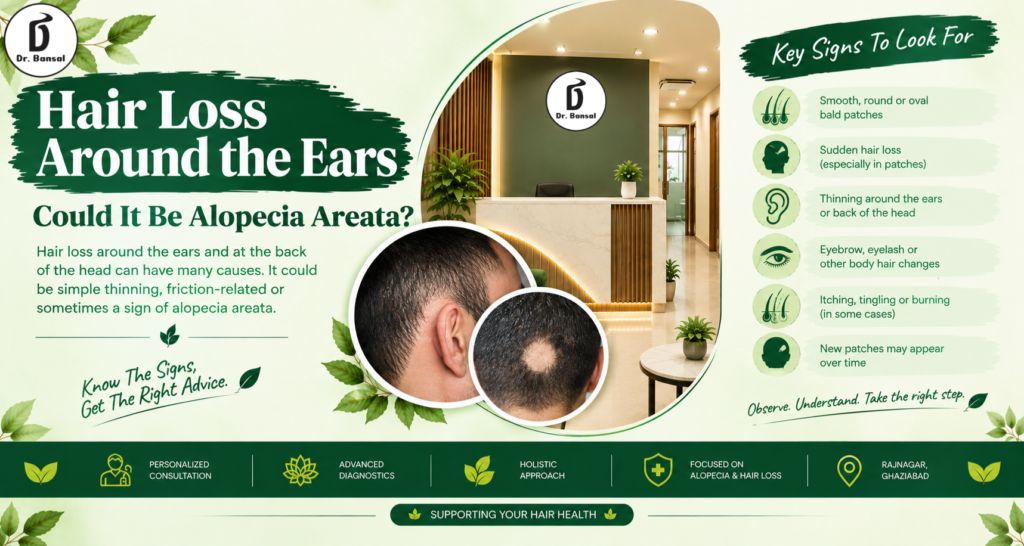
When alopecia areata causes Hair Loss Around the Ears, you may notice:
- A smooth, round or oval bald patch.
- A clear difference between the affected area and the surrounding hair.
- Sudden loss rather than gradual thinning.
- Additional patches appearing on other parts of the scalp.
- Hair loss affecting the eyebrows, eyelashes, beard, or other body areas.
- Occasional itching, tingling, or burning around an affected area.
The skin inside an alopecia areata patch often looks relatively normal, without obvious scarring. Some people may also notice changes to their fingernails or toenails.
Not everyone experiences all these signs. In addition, certain scalp conditions can cause patchy hair loss with scaling, redness, or irritation. This makes a proper examination important when Hair Loss Around the Ears is new or unexplained.
Hair Loss Around the Ears vs. Traction or Friction
Another possible explanation is repeated pulling or rubbing.
Hairstyles that place continuous tension on the hair can contribute to traction-related hair loss, particularly around the edges of the scalp. Repeated friction from headwear or other sources may also contribute to breakage in some circumstances.
The pattern can provide clues:
- Alopecia areata: Often produces smooth, clearly defined bald patches that appear suddenly.
- Traction-related loss: May occur around areas exposed to repeated pulling and can involve broken hairs or gradual thinning.
- Hair breakage: Often leaves hairs of different lengths rather than a completely smooth bald area.
- Other scalp conditions: May involve scaling, redness, tenderness, or other skin changes.
These differences are not always obvious. Hair Loss Around the Ears should therefore be assessed in context rather than attributed automatically to a hairstyle or a particular disease.
Can Hair Loss Around the Ears Spread?
It can, depending on the underlying cause.
In alopecia areata, some people develop one small patch, while others develop additional patches over time. Occasionally, separate areas may join together, producing a larger area of hair loss.
The course is unpredictable. Hair may regrow in one patch while another area becomes affected, and the amount of regrowth varies from person to person.
If Hair Loss Around the Ears begins spreading toward the back of the scalp or other hair-bearing areas, arrange a professional assessment rather than waiting for the pattern to become extensive.
How Is Hair Loss Around the Ears Diagnosed?
A professional assessment usually begins with questions about when the hair loss started, how quickly it developed, and whether you have noticed similar patches before.
The affected area may be examined closely, along with the rest of the scalp. Depending on the pattern, a professional may also check the eyebrows, eyelashes, other hair-bearing areas, and nails.
A magnifying scalp examination can help identify changes in the hair and follicles. Additional investigations may be considered if the appearance is unclear or another condition needs to be ruled out.
For Hair Loss Around the Ears, the goal is to identify the likely cause rather than assume that every patch represents alopecia areata.
What Should You Do If You Notice a Bald Patch?
If you discover a new bald patch, take note of its location and when you first noticed it. You may find it useful to keep dated photographs to track whether the area changes over time.
Avoid repeatedly rubbing, scratching, or pulling at the patch to test whether the hair is secure. Also, do not assume that a home remedy or cosmetic product will address the underlying cause.
Seek professional evaluation if Hair Loss Around the Ears is sudden, expanding, recurring, or accompanied by other patches, eyebrow or eyelash loss, or unusual scalp changes.
If the area is painful, significantly inflamed, scaly, or developing sores, it is especially important to have it assessed because these features can point toward causes other than typical alopecia areata.
Why You Need to Visit Dr. Bansal Hair Rebirth Centre
If you are experiencing Hair Loss Around the Ears in Ghaziabad or nearby areas and are unsure what is causing it, a professional hair and scalp assessment can help clarify the situation.
Dr. Bansal Hair Rebirth Centre in Raj Nagar, Ghaziabad, focuses on alopecia and various hair and scalp concerns. The centre describes its approach as personalized, with attention to individual hair-loss patterns and scalp assessment.
A consultation may be helpful when Hair Loss Around the Ears appears suddenly, forms smooth bald patches, spreads toward the back of the scalp, or returns after periods of regrowth.
The centre is located at MZL 07/08, Sumedha Tower, Ansal Building, Raj Nagar, Ghaziabad, Uttar Pradesh 201002.
Contact: +91-9953250910
Understanding the reason behind your hair loss is an important first step toward making informed decisions about your hair and scalp health.
Contact us. https://drbansalhairrebirthcenter.in/contact-us/.
Frequently Asked Questions
Can alopecia areata start behind the ears?
Yes. Alopecia areata can affect the sides or back of the scalp, including areas near the ears.
Is Hair Loss Around the Ears always alopecia areata?
No. Friction, repeated pulling, hair breakage, and other scalp conditions can also cause hair loss in this area.
What is ophiasis-pattern alopecia areata?
It is a pattern in which alopecia areata causes band-like hair loss along the sides and lower back of the scalp.
Can hair grow back after alopecia areata?
Hair can regrow in affected areas, but the timing and extent of regrowth vary between individuals. The condition may also recur.
When should I get Hair Loss Around the Ears checked?
Consider professional evaluation if the hair loss appears suddenly, forms smooth patches, spreads, returns repeatedly, or occurs alongside other hair or scalp changes.
Final Thoughts
Hair Loss Around the Ears can have several explanations, and the location alone does not reveal the cause. A smooth bald patch may be associated with alopecia areata, while gradual thinning, breakage, or scalp irritation may suggest other possibilities.
Pay attention to how the patch develops, whether it expands, and whether other areas of hair are affected. If the pattern is sudden or unexplained, a professional assessment can help you understand what may be happening.
Recognizing unusual hair-loss patterns early can help you seek appropriate guidance and avoid making assumptions about your scalp health.
Contact Details
Dr. Bansal Hair Rebirth Center
MZ-07/08, Sumedha Tower, RDC, Raj Nagar, Ghaziabad
Phone: +91 8595340077
Website: https://drbansalhairrebirthcenter.in/
know more about us – https://vedantamayurveda.in/