Seeing extra hair fall while dealing with dandruff can naturally make you concerned. You may wonder whether the flakes are causing your hair loss or whether something else is happening underneath the scalp.
Thank you for reading this post, don't forget to subscribe!Hair Loss With Dandruff can have several possible explanations. Everyday scalp flaking and temporary shedding may occur together, but sudden smooth bald patches are a different pattern and can sometimes be associated with alopecia areata.
Understanding the difference between Hair Loss With Dandruff and patchy alopecia can help you recognize when your scalp needs closer attention.
Can Dandruff Cause Hair Loss?
Dandruff itself does not usually cause the type of sudden, smooth bald patches associated with alopecia areata. However, a flaky or irritated scalp can make hair care more difficult and may be associated with increased scratching, irritation, or temporary hair breakage.
When someone notices Hair Loss With Dandruff, it is therefore important to look beyond the flakes.
Ask yourself:
- Is hair falling from the entire scalp?
- Are there clearly defined bald patches?
- Is the scalp only flaky, or is it also red or irritated?
- Did the hair loss appear suddenly?
- Are eyebrows, eyelashes, beard, or other areas also losing hair?
- Is the hair loss continuing or spreading?
These details can provide useful clues about what may be happening.
What Does Alopecia Areata Look Like?
Alopecia areata can cause sudden hair loss in clearly defined areas. A common pattern is a round or oval smooth patch where hair has disappeared.
Although it often affects the scalp, alopecia areata can also affect the beard, eyebrows, eyelashes, and other hair-bearing areas.
This means that Hair Loss With Dandruff should not automatically be attributed to the scalp flakes if you are also noticing one or more smooth bald patches.
The skin inside an alopecia areata patch may look relatively normal, although some people can experience sensations such as itching, tingling, or burning around affected areas.
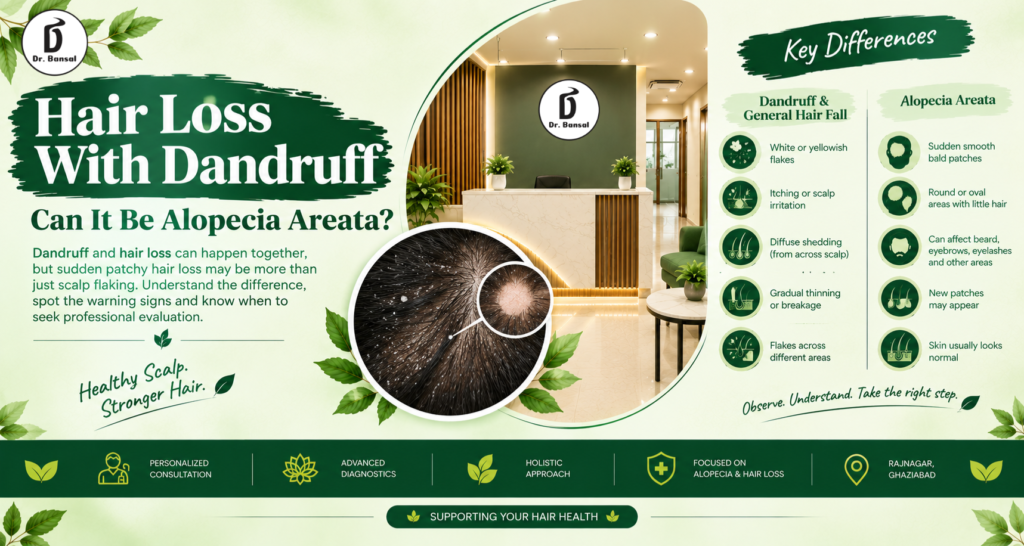
Hair Loss With Dandruff vs. Alopecia Areata
One of the easiest ways to understand the difference is to look at the pattern.
With ordinary scalp flaking and shedding, you may notice:
- White or yellowish flakes
- Itching or scalp irritation
- More loose hair during brushing or washing
- Hair appearing generally thinner because of increased shedding or breakage
- Flaking spread across different areas of the scalp
With alopecia areata, you may notice:
- Sudden smooth bald patches
- Round or oval areas with little or no hair
- Clearly defined changes in hair density
- New patches appearing over time
- Hair loss affecting the beard, eyebrows, eyelashes, or other areas
Therefore, Hair Loss With Dandruff can sometimes involve two separate issues occurring at the same time.
Why Does the Pattern Matter?
The pattern of hair loss is often more informative than the number of hairs you see in your comb.
For example, finding several loose hairs after washing does not necessarily indicate alopecia areata. Hair naturally sheds as part of the normal hair-growth cycle.
On the other hand, discovering a smooth bald patch that was not there recently is a reason to pay closer attention.
If Hair Loss With Dandruff continues and you begin seeing clearly defined areas of missing hair, it is better not to assume that dandruff is responsible for everything.
A professional assessment can help distinguish different patterns of hair loss.
Can Scratching Make Hair Fall?
Frequent or vigorous scratching can irritate the scalp and may contribute to hair breakage or make an existing scalp problem more uncomfortable.
However, scratching does not explain every type of hair loss.
If you have Hair Loss With Dandruff and notice a distinct bald patch, the patch itself deserves attention rather than simply increasing scalp-cleaning or scratching less.
The appearance of the affected area, the timing of the hair loss, and whether other body hair is affected can all be important.
What If the Scalp Is Flaky Inside a Bald Patch?
A flaky scalp does not automatically mean that a bald patch is caused by dandruff.
Different scalp conditions can produce flaking, irritation, redness, or other visible changes. Some causes of hair loss can also look different from classic alopecia areata.
This is why Hair Loss With Dandruff can sometimes be difficult to interpret without examining the scalp properly.
If a bald patch has significant scaling, sores, swelling, discharge, or pronounced redness, it is especially important to have the area evaluated rather than assuming it is ordinary dandruff.
Can Alopecia Areata and Dandruff Happen Together?
Yes. Having dandruff or scalp flaking does not prevent someone from developing another hair-loss condition.
A person may therefore experience Hair Loss With Dandruff while also developing alopecia areata.
The important point is that one condition should not automatically be used to explain every symptom.
If you have general scalp flaking but suddenly notice a smooth bald patch, eyebrow thinning, beard patches, or additional areas of hair loss, consider getting the pattern assessed.
How Is Sudden Hair Loss Evaluated?
An evaluation usually begins with questions about when the hair loss started and how it has changed.
A professional may want to know:
- Whether the hair loss was sudden or gradual
- Whether it appears as patches or general thinning
- Whether similar episodes happened previously
- Whether family members have experienced similar hair loss
- Whether eyebrows, eyelashes, beard, or body hair are affected
- Whether the scalp has itching, scaling, redness, or other changes
- Whether nail changes have appeared
The scalp and affected areas can then be examined closely. In some situations, additional investigation may be appropriate depending on the pattern and individual history.
This approach is particularly useful when Hair Loss With Dandruff does not have an obvious explanation.
What Should You Do About Hair Loss With Dandruff?
If you notice extra shedding alongside scalp flakes, try not to immediately assume that you have alopecia areata.
Instead, observe the pattern.
Take note of whether the shedding is spread across the scalp or concentrated in one or more clearly defined areas. Also pay attention to whether the problem is improving, staying the same, or progressing.
If Hair Loss With Dandruff becomes sudden, extensive, persistent, or patchy, professional evaluation can help clarify what may be happening.
Avoid judging the condition only by the amount of hair in your comb or shower drain. The location and appearance of the loss can provide much more useful information.
Why You Need to Visit Dr. Bansal Hair Rebirth Centre
If you are experiencing Hair Loss With Dandruff in Ghaziabad or nearby areas and cannot determine whether you are dealing with ordinary scalp flaking, shedding, or alopecia areata, a professional hair and scalp evaluation can provide greater clarity.
Dr. Bansal Hair Rebirth Centre in Raj Nagar, Ghaziabad, focuses on alopecia and a range of hair and scalp concerns. The centre states that its team has more than a decade of experience with complex hair-loss conditions, particularly alopecia areata, and emphasizes personalized assessment.
A visit may be particularly useful when Hair Loss With Dandruff is accompanied by sudden bald patches, recurring hair loss, eyebrow or eyelash changes, beard patches, or unusual scalp changes.
The centre is located at MZL 07/08, Sumedha Tower, Ansal Building, Raj Nagar, Ghaziabad, Uttar Pradesh 201002. The official contact number is +91-9953250910.
Contact us. https://drbansalhairrebirthcenter.in/contact-us/.
Frequently Asked Questions
Can dandruff cause sudden bald patches?
Typical dandruff does not usually cause the smooth, clearly defined bald patches commonly associated with alopecia areata. Sudden patches should therefore be evaluated rather than automatically blamed on dandruff.
Is Hair Loss With Dandruff always alopecia areata?
No. Hair Loss With Dandruff can have different causes. Scalp flaking and hair shedding may occur together without alopecia areata being involved.
Can alopecia areata affect areas other than the scalp?
Yes. Alopecia areata can affect the beard, eyebrows, eyelashes, and other areas where hair grows.
When should I get Hair Loss With Dandruff checked?
Consider an evaluation if the hair loss is sudden, persistent, rapidly increasing, forms smooth patches, keeps returning, or affects other hair-bearing areas.
Can hair grow back after alopecia areata?
Hair can regrow in areas affected by alopecia areata, but the timing and pattern of regrowth can vary considerably between individuals.
Final Thoughts
Hair Loss With Dandruff can be confusing because scalp flakes and increased shedding may appear around the same time. However, dandruff should not automatically be considered the explanation for sudden or patchy hair loss.
The most useful clues are the pattern, timing, appearance, and progression of the hair loss. Diffuse shedding is different from a smooth, clearly defined bald patch, and changes involving eyebrows, eyelashes, beard, or other areas can provide additional clues.
If you are experiencing Hair Loss With Dandruff and the pattern seems unusual or continues to change, getting your scalp and hair properly evaluated can help you understand the situation instead of relying on guesswork.
Contact Details
Dr. Bansal Hair Rebirth Center
MZ-07/08, Sumedha Tower, RDC, Raj Nagar, Ghaziabad
Phone: +91 8595340077
Website: https://drbansalhairrebirthcenter.in/
know more about us – https://vedantamayurveda.in/