
Hair is often closely tied to confidence, identity, and self-expression. For people living with alopecia, losing hair is not just a physical change—it can also be an emotional journey. While friends, family, and colleagues usually mean well, certain comments can unintentionally make the situation even more difficult.
Thank you for reading this post, don't forget to subscribe!At Dr. Bansal Hair Rebirth Centre, we’ve worked with many individuals affected by Alopecia Areata, Alopecia Totalis, and Alopecia Universalis. One thing we hear repeatedly is that insensitive remarks often hurt more than the condition itself.
If you know someone with alopecia, understanding what to say—and what not to say—can make a meaningful difference. Compassion, empathy, and awareness go much further than curiosity or assumptions.
Understanding Alopecia
Alopecia is an autoimmune condition in which the body’s immune system mistakenly attacks healthy hair follicles, resulting in hair loss. Depending on the type, hair loss may affect small areas of the scalp or extend to the eyebrows, eyelashes, beard, and the entire body.
Importantly, alopecia is not contagious, and in most cases, it is not caused by poor hygiene, hair products, or lack of care.
Every person’s experience is different, which is why sensitivity matters.
Why Your Words Matter
Many people living with alopecia already struggle with:
- Reduced self-confidence
- Anxiety about appearance
- Social discomfort
- Fear of being judged
- Emotional stress
A casual comment may seem harmless to you, but it can reinforce insecurities that the person is already dealing with.
Being supportive starts with choosing your words carefully.
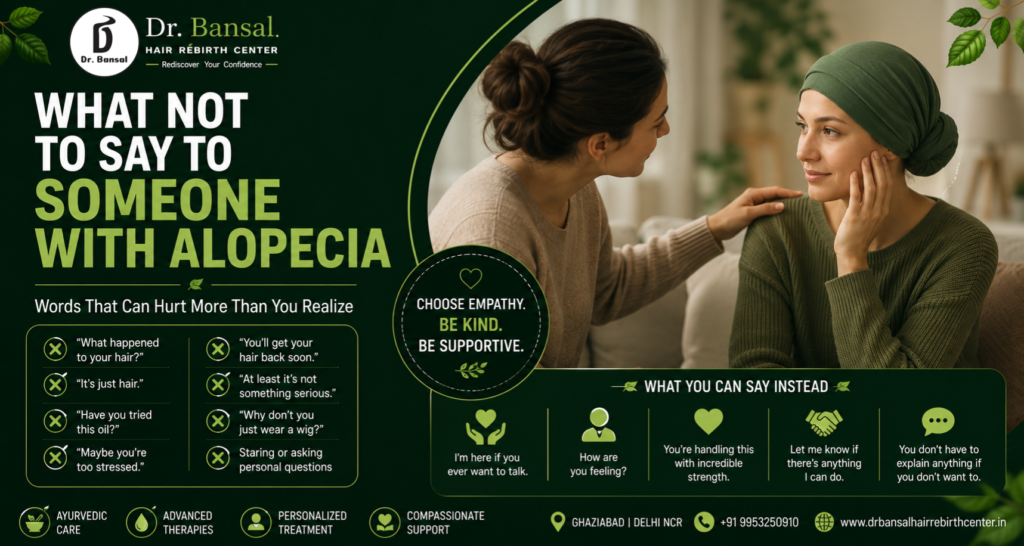
1. “What Happened to Your Hair?”
This is probably one of the most common questions someone with alopecia hears.
Although curiosity is natural, asking this immediately can make the person feel uncomfortable or as though their appearance is being scrutinized.
Instead Say:
“How have you been?”
Let them decide whether they want to discuss their condition.
2. “It’s Just Hair.”
While intended to be comforting, this statement minimizes the emotional impact of hair loss.
Hair loss can affect confidence, relationships, career interactions, and mental well-being.
Acknowledging someone’s feelings is far more helpful than dismissing them.
Better Alternative
“I can only imagine how challenging this must be.”
3. “Have You Tried This Oil?”
Many people immediately recommend home remedies, miracle oils, or internet hacks.
The truth is that alopecia is an autoimmune condition. There is no universal home remedy that works for everyone.
Offering unsolicited advice may unintentionally suggest that the person hasn’t tried hard enough.
4. “Maybe You’re Too Stressed.”
Stress may sometimes contribute to flare-ups, but it is not the sole cause of alopecia.
Blaming stress oversimplifies a complex medical condition and may even make the person feel responsible for their illness.
5. “You’ll Get Your Hair Back Soon.”
While optimism is appreciated, making promises about recovery can create false hope.
Hair regrowth varies greatly depending on the type and severity of alopecia.
Instead, simply offer encouragement without making guarantees.
6. “At Least It’s Not Something Serious.”
To the person experiencing alopecia, it is serious.
Although alopecia is not life-threatening, its emotional effects can be significant.
Comparing someone’s struggle to another illness rarely provides comfort.
7. “You Look Better with Hair.”
Even if said unintentionally, this can deeply affect someone with alopecia.
The comment suggests that the person’s current appearance is somehow less acceptable.
Instead, compliment qualities that aren’t related to hair.
For example:
- “You look great today.”
- “That outfit really suits you.”
- “It’s always nice talking to you.”
8. “Why Don’t You Just Wear a Wig?”
Some people choose wigs.
Others prefer scarves.
Many proudly embrace baldness.
Every individual has their own way of coping.
Avoid assuming that everyone wants to hide their condition.
Respect personal choices.
9. Staring Without Saying Anything
Sometimes silence can speak louder than words.
Repeatedly looking at someone’s scalp, eyebrows, or head can make them feel self-conscious.
Maintain natural eye contact and focus on the conversation—not their appearance.
10. Asking Personal Medical Questions
Questions like:
- “Is it contagious?”
- “Can doctors fix it?”
- “Will all your hair fall out?”
- “Does your family have it?”
may feel intrusive.
If someone with alopecia wants to discuss their medical journey, they’ll usually bring it up themselves.
What You Should Say Instead
Supportive communication doesn’t have to be complicated.
Here are better ways to show you care:
- “I’m here if you ever want to talk.”
- “How are you feeling?”
- “You’re handling this with incredible strength.”
- “Let me know if there’s anything I can do.”
- “You don’t have to explain anything if you don’t want to.”
Sometimes simply listening is the greatest support you can offer.
How Families and Friends Can Help
If someone close to you has alopecia, consider these practical ways to support them:
Listen Without Judging
Allow them to express emotions without trying to “fix” everything.
Respect Their Privacy
Don’t discuss their condition with others unless they’ve given permission.
Avoid Constantly Talking About Hair
Remember that they have many interests beyond their diagnosis.
Encourage Professional Care
If they haven’t already, gently encourage them to consult experienced specialists rather than relying on social media advice.
How Dr. Bansal Hair Rebirth Centre Supports Patients
At Dr. Bansal Hair Rebirth Centre, we understand that treating alopecia involves more than addressing hair loss.
Our approach focuses on:
- Comprehensive scalp assessment
- Personalized Ayurvedic treatment plans
- Advanced hair restoration therapies
- Lifestyle and nutritional guidance
- Continuous monitoring and patient education
- Emotional support through compassionate care
We believe every patient deserves to feel understood, respected, and confident throughout their treatment journey.
Contact us. https://drbansalhairrebirthcenter.in/contact-us/
Final Thoughts
If you know someone with alopecia, remember that your words have the power to comfort—or unintentionally hurt.
Avoid making assumptions, offering unsolicited remedies, or focusing only on appearance. Instead, choose empathy, patience, and understanding.
Alopecia may change how someone looks, but it does not define who they are.
At Dr. Bansal Hair Rebirth Centre, we are committed to helping individuals with alopecia through personalized Ayurvedic and advanced treatment approaches while also raising awareness about the importance of emotional support and compassion.
Sometimes, the kindest thing you can say is simply:
“I’m here for you.”
Frequently Asked Questions (FAQs)
Is alopecia contagious?
No. Alopecia is an autoimmune condition and cannot spread from one person to another.
Should I ask someone about their hair loss?
Only if they seem comfortable discussing it. Never pressure someone to explain their condition.
Can emotional support help someone with alopecia?
Yes. While emotional support doesn’t treat the condition itself, it can significantly improve confidence, reduce stress, and help individuals cope with the emotional challenges of hair loss.
Where can I seek treatment for alopecia?
If you’re experiencing patchy hair loss or suspect alopecia, consult experienced specialists like the team at Dr. Bansal Hair Rebirth Centre for a proper diagnosis and a personalized treatment plan.
Contact Details
Dr. Bansal Hair Rebirth Center
MZ-07/08, Sumedha Tower, RDC, Raj Nagar, Ghaziabad
Phone: +91-9953250910
Website: https://drbansalhairrebirthcenter.in/
know more about us – https://vedantamayurveda.in/